
Lifestyle Medicine for Adolescents and Adults with Down Syndrome
June 15, 2026
Key Points
- Promoting one’s own health is an important factor in overall improved health.
- People with Down syndrome can participate in their own health promotion.
- Methods to promote participation in healthy behaviors include encouragement, modeling of healthy behavior, and providing the right tools.
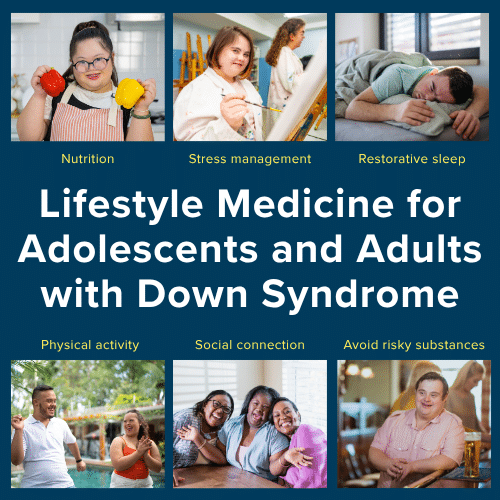
- Lifestyle medicine is a medical specialty that supports setting goals in one or more of the six “pillars” of healthy behavior.
What is health promotion?
Health promotion is the process of helping people take control of their own health and improve it over time. The goal is to empower people to build healthy habits and use simple strategies in their daily lives that support their well-being.
There are many ways to describe health promotion. One related approach is lifestyle medicine, which is an evidence-based medical specialty that focuses on treating the root causes of disease through healthy lifestyle choices such as good nutrition, regular physical activity, quality sleep, stress management, and social connection. In past discussions, we have related health promotion to creating “a recipe for health.” No matter the name, the idea is the same: understanding and encouraging everyday behaviors that improve health and reduce the risk of illness.
Healthcare visits are an important part of staying healthy. As a clinic serving adolescents and adults with Down syndrome, we strongly encourage regular appointments with your doctor or other healthcare professionals. These visits are a good time to talk about health promotion and ask questions such as:
- What can I do to promote my health outside of clinic visits?
- What daily habits are helping my health?
- Are there changes I can make to feel even better?
This article focuses on the actions you can take at home and in your daily life to support your health.
We believe that people with Down syndrome can take an active role in their own health. With the right tools, clear information, encouragement, and good role models, individuals with Down syndrome can build healthy habits and benefit from health promotion. Taking part in these activities is an important step toward long-term health and success.
Health promotion is a household affair
One of the ways to teach and support healthy habits is for the whole household to practice them together.
Some examples include:
- Eating meals together and serving the same healthy foods to everyone
- Doing fun physical activity together (for example, a sibling dancing with their sibling with Down syndrome)
- Choosing a “family bedtime”
- Limiting electronics in the bedroom or having a household charging station in the kitchen
Family members or roommates can encourage each other to develop and meet goals.
Make a goal
Setting goals can be a helpful approach when working on health promotion. One type of goal-setting strategy is a SMART goal.
- Specific: clearly defined and straightforward
- Measurable: you can track it
- Achievable: realistic for you right now
- Relevant: aligns with overall effort to improve health
- Time-bound: has a deadline to help maintain focus
We have found that choosing one goal is a good place to start. Too many changes at once can feel overwhelming and reduce the chance for success. It also helps to start slow and small to make sure that the “achievable” quality of the goal is truly achievable. Success of any size can encourage the person and promote better follow-through.
Resources to support adults with Down syndrome in making goals are available in the Resources section below.
The myth of “all or nothing” thinking
A common misconception about efforts to improve health is called “all or nothing” thinking. That way of approaching health thinks, “Unless it is perfect, it is not worth doing.” This is false. Even small changes (or starting with small changes) can be beneficial.
The pillars
The American College of Lifestyle Medicine describes six pillars of lifestyle medicine. Each pillar has a corresponding article in our Resource Library.
- Nutrition
- Physical activity
- Stress management
- Restorative sleep
- Social connection*
- Risky substance avoidance
*We often add social skills to the social connectedness pillar. We have found that learning social skills can lead to greater success in the other pillars, particularly social connections.
Resources
Down syndrome
Health Promotion for Adults with Down Syndrome (CARE Down Syndrome)
Helping a Person with Down Syndrome Make Goals
Tips for Building a New Habit or Routine
All Health Promotion Resources
General
About Lifestyle Medicine (American College of Lifestyle Medicine)
References
Grega ML, Shalz JT, Rosenfeld RM, et al. American College of Lifestyle Medicine expert consensus statement: Lifestyle medicine for optimal outcomes in primary care. Am J Lifestyle Med. 2023;18(2):269-293. doi:10.1177/15598276231202970
Join our mailing list
Sign up to receive emails with information on health topics for teens and adults with Down syndrome, updates on research and education as well as information about upcoming events, classes and programs.