
Lifestyle Medicine Pillars: Physical Activity
June 15, 2026
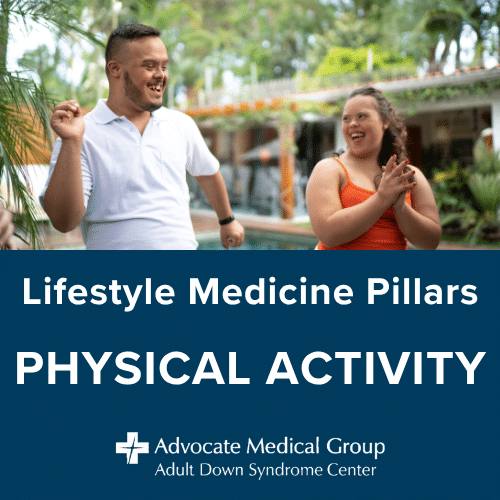
As described in our article Lifestyle Medicine for Adolescents and Adults with Down Syndrome, physical activity is one of the pillars of lifestyle medicine identified by the American College of Lifestyle Medicine.
Why exercise?
Benefits can include:
- Improved cognitive function and memory
- Healthier weight
- Better mental health
- Prevention of other health conditions
What forms of exercise are optimal for adolescents and adults with Down syndrome?
There are no studies that definitively tell us what the best exercises are for people with Down syndrome. Exercise selection can be affected by:
- Interests, skills, and preferences
- Access
- Other health conditions
- Body physiology and anatomy
- And others
Accounting for these factors can help with choosing exercises that are right for an individual.
What are exercise guidelines for adults?
Examples of goals
I will dance to 3 songs, 5 days per week.
I will get 5,000 steps 6 days a week for 3 weeks.
Resources
Adult Down Syndrome Center
Heart Rates and Exercise in People with Down Syndrome
Lifestyle Medicine for Adolescents and Adults with Down Syndrome
Tips for Being Physically Active Video
All Exercise and Physical Activity Resources
General
About Lifestyle Medicine (American College of Lifestyle Medicine)
Exercise Snacks (Stanford Lifestyle Medicine)
Recommendations for Physical Activity in Adults (American Heart Association)
WHO Guidelines on Physical Activity and Sedentary Behaviour (World Health Organization)
References
Fleming V, Piro-Gambetti B, Handen B, et al. Physical activity and physical and mental health in middle-aged adults with Down syndrome. J Policy Pract Intellect Disabil. 2022;19(4):408-418. doi:10.1111/jppi.12434
Piercy KL, Troiano RP. Physical activity guidelines for Americans from the US Department of Health and Human Services. Circ Cardiovasc Qual Outcomes. 2018;11(11):e005263. doi:10.1161/CIRCOUTCOMES.118.005263
Rodríguez MÁ, Quintana-Cepedal M, Cheval B, Thøgersen-Ntoumani C, Crespo I, Olmedillas H. Effect of exercise snacks on fitness and cardiometabolic health in physically inactive individuals: Systematic review and meta-analysis. Br J Sports Med. 2026;60(2):133-141. doi:10.1136/bjsports-2025-110027
Warburton DE, Nicol CW, Bredin SS. Health benefits of physical activity: The evidence. CMAJ. 2006;174(6):801-809. doi:10.1503/cmaj.051351
Join our mailing list
Sign up to receive emails with information on health topics for teens and adults with Down syndrome, updates on research and education as well as information about upcoming events, classes and programs.