
Use of Probiotics by People with Down Syndrome
May 16, 2025
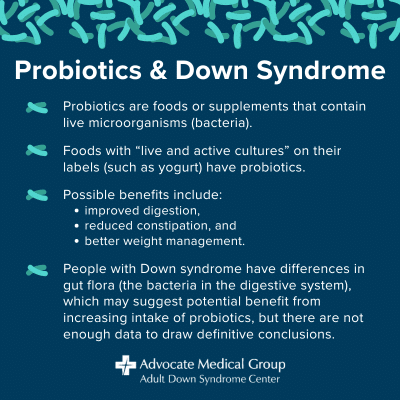
Key Points
- Probiotics are foods or supplements that contain live microorganisms (e.g., bacteria).
- Probiotics can be ingested by eating certain foods (e.g., yogurt) or by taking a supplement.
- While there are several potential benefits to increasing intake of probiotics, there are limited data in the benefit of taking probiotics in people without Down syndrome.
- There is a difference in the gut flora (the bacteria in the digestive system) in people with Down syndrome compared to people without Down syndrome.
- The difference in gut flora in people with Down syndrome may suggest potential benefit from increasing intake of probiotics, but there are not enough data to draw definitive conclusions.
What are probiotics?
Probiotics are foods or supplements that contain live microorganisms (e.g., bacteria). Foods with labels that say “live and active cultures” contain probiotics. Yogurt and fermented foods are two examples. There are many types of probiotic supplements with different types and amounts of microorganisms.
Probiotic supplements are often taken to support gut or gastrointestinal health. The NIH National Center for Complementary and Integrative Health reports they are generally considered safe except for premature infants. However, their effect on people can vary, and more study is needed. It is important to discuss use of probiotic supplements with your health care professional before starting to take them.
A note about prebiotics: Prebiotics are foods that promote the growth of “good” bacteria in the gut. Unlike probiotics, they do not contain the live microorganisms. Examples include fruits, vegetables, whole grains, and others.
Potential benefits of probiotics
Many people report they feel better when taking a probiotic supplement or eating a diet that contains probiotics. Various benefits are reported such as:
- Improved digestion
- Reduced constipation
- Improved weight management
- An overall sense of good health
- And others
However, the research on the benefits of probiotics in people with or without Down syndrome is limited. A 2024 article reviewing available research concluded:
“In summary, prebiotics and probiotics demonstrate promise in the prevention and treatment of certain GI disorders, as an adjunct or alternative to conventional therapies. However, these data are difficult to translate to specific clinical guidelines given the wide variation in prebiotic type(s), probiotic strain(s), dose, and/or duration of treatment used in each study. Furthermore, standardized reporting of safety outcomes and studies examining their potential long-term effects are severely lacking.”
Some of the findings of the studies that have been done (in people without Down syndrome) are described below.
Constipation
A Cochrane review on probiotics in children was published in 2022. A Cochrane review includes a thorough search and review of available medical literature on a topic, a summary of the information, and a conclusion based on the review. The review of available studies did not find sufficient evidence that probiotics are effective in treating chronic constipation or changing the frequency of bowel movements in children.
A 2023 article that reviewed several studies on the impact of probiotics in the elderly found that constipation was reduced if probiotics were used on a longer-term basis (4 or more weeks).
Another analysis of multiple studies reported that certain probiotics (those containing Bifidobacterium lactis) may improve response to treatment of constipation, including increasing stool frequency and reducing constipation symptoms.
Diarrhea from antibiotics
Taking a probiotic when taking an antibiotic may reduce antibiotic-associated diarrhea. Antibiotics are taken to fight an infection caused by bacteria. In addition to killing the “bad” bacteria, they may kill “good” bacteria that is found naturally in our bodies. Probiotics may help to replenish the good bacteria in our bodies. However, studies have reached conflicting conclusions (see the References section below).
Weight management
The results are mixed on the effect of probiotic supplements on weight loss. Some studies show benefit while others do not (see the References section below). One study indicated that eating yogurt, which is a source of probiotics, may benefit weight management.
Cognition
A 2023 article that reviewed several studies on the impact of probiotics in the elderly reported that older adults who took probiotics demonstrated some benefit on a few subsets of cognitive tests. However, the results were limited.
Should people with Down syndrome take probiotic supplements?
Like people without Down syndrome, some people with Down syndrome report benefit from taking probiotic supplements or increasing foods with probiotics in their diet. However, the research in people with Down syndrome is even more limited than the research in people without Down syndrome.
In general, the answer depends on the individual. Some individuals who take probiotic supplements experience relief from constipation or diarrhea. Others may experience worsening bowel issues such as the development of diarrhea. For many people with Down syndrome, trying a probiotic and seeing how it makes them feel is the only way to assess benefit. Some individuals report they feel fine without increasing probiotics and, therefore, choose not to increase them in their diet or start taking supplements.
There is a difference in the gut microbiome (the bacteria living in the gastrointestinal tract) of people with Down syndrome. There is a possible link between the gut microbiome differences and decreased immune function, earlier aging, behavior, and impaired cognition in people with Down syndrome. However, research has not been reported that demonstrates that increasing probiotic ingestion through foods or supplements reduces these concerns. Much more study is needed.
In general, for individuals with Down syndrome:
- If an individual is experiencing gastrointestinal issues such as constipation or frequent diarrhea, increasing probiotics through diet or supplements might be considered.
- If an individual is taking an antibiotic for an infection, it may be beneficial to also take a probiotic while taking the antibiotic.
- An individual may want to consider probiotics through diet or supplements as part of a weight management program.
Resources
Down Syndrome
General
Prebiotics: Understanding Their Role in Gut Health (Harvard Medical School)
Probiotics (Cleveland Clinic)
Probiotics: Usefulness and Safety (NIH National Center for Complementary and Integrative Health)
References
Biagi E, Candela M, Centanni M, et al. Gut microbiome in Down syndrome. PLoS One. 2014;9(11):e112023. doi:10.1371/journal.pone.0112023
Éliás AJ, Barna V, Patoni C, et al. Probiotic supplementation during antibiotic treatment is unjustified in maintaining the gut microbiome diversity: A systematic review and meta-analysis. BMC Med. 2023;21(1):262. doi:10.1186/s12916-023-02961-0
Fernández-Alonso M, Aguirre Camorlinga A, Messiah SE, Marroquin E. Effect of adding probiotics to an antibiotic intervention on the human gut microbial diversity and composition: A systematic review. J Med Microbiol. 2022;71(11):10.1099/jmm.0.001625. doi:10.1099/jmm.0.001625
Issa I, Moucari R. Probiotics for antibiotic-associated diarrhea: Do we have a verdict?. World J Gastroenterol. 2014;20(47):17788-17795. doi:10.3748/wjg.v20.i47.17788
Panahi S, Tremblay A. The potential role of yogurt in weight management and prevention of type 2 diabetes. J Am Coll Nutr. 2016;35(8):717-731. doi:10.1080/07315724.2015.1102103
Perna S, Ilyas Z, Giacosa A, et al. Is probiotic supplementation useful for the management of body weight and other anthropometric measures in adults affected by overweight and obesity with metabolic related diseases? A systematic review and meta-analysis. Nutrients. 2021;13(2):666. doi:10.3390/nu13020666
Rau S, Gregg A, Yaceczko S, Limketkai B. Prebiotics and probiotics for gastrointestinal disorders. Nutrients. 2024;16(6):778. doi:10.3390/nu16060778
Recharla N, Choi J, Puligundla P, Park SJ, Lee HJ. Impact of probiotics on cognition and constipation in the elderly: A meta-analysis. Heliyon. 2023;9(7):e18306. doi:10.1016/j.heliyon.2023.e18306
Ren S, Wang X, Qin J, et al. Altered gut microbiota correlates with cognitive impairment in Chinese children with Down’s syndrome. Eur Child Adolesc Psychiatry. 2022;31(1):189-202. doi:10.1007/s00787-021-01799-2
Rodgers B, Kirley K, Mounsey A. PURLs: prescribing an antibiotic? Pair it with probiotics. J Fam Pract. 2013;62(3):148-150.
Sergeev IN, Aljutaily T, Walton G, Huarte E. Effects of synbiotic supplement on human gut microbiota, body composition and weight loss in obesity. Nutrients. 2020;12(1):222. doi:10.3390/nu12010222
Torres B, Sánchez MC, Virto L, Llama-Palacios A, Ciudad MJ, Collado L. Use of probiotics in preventing and treating excess weight and obesity. A systematic review. Obes Sci Pract. 2024;10(3):e759. doi:10.1002/osp4.759
van der Schoot A, Helander C, Whelan K, Dimidi E. Probiotics and synbiotics in chronic constipation in adults: A systematic review and meta-analysis of randomized controlled trials. Clin Nutr. 2022;41(12):2759-2777. doi:10.1016/j.clnu.2022.10.015
Wallace C, Sinopoulou V, Gordon M, et al. Probiotics for treatment of chronic constipation in children. Cochrane Database Syst Rev. 2022;3(3):CD014257. doi:10.1002/14651858.CD014257.pub2
Join our mailing list
Sign up to receive emails with information on health topics for teens and adults with Down syndrome, updates on research and education as well as information about upcoming events, classes and programs.