
Constipation in People with Down Syndrome
May 14, 2025
Key Points
- Constipation is a decrease in the normal volume of bowel movements (poop).
- Constipation is more common in people with Down syndrome.
- There are several means of reducing constipation including drinking more fluid, eating more fiber, and exercising regularly.
- Constipation can cause more serious complications that require further diagnosis and treatment by a medical professional.
What is constipation?
Constipation is an overall decrease in the volume of bowel movements (amount of poop/stool). It can be caused by a change in frequency, size, consistency, and/or ease of bowel movements. Fewer than three bowel movements per week is considered constipation as is having difficulty passing stool.
For a person to have “normal” bowel movements, it is not necessary to have a daily bowel movement. Having between three bowel movements per week and three per day is considered normal.
Symptoms
Constipation can present with a wide range of symptoms. Symptoms and signs of constipation may include:
- decreased frequency of bowel movements
- increased size of infrequent bowel movements
- small, hard bowel movements
- occasional formed stool with intermittent diarrhea
- bloating of the abdomen
- abdominal discomfort
- pain with having a bowel movement
- a persistent, urgent, and often painful feeling of needing to have a bowel movement, even when there is little or no stool to pass (tenesmus)
- decreased appetite
- stool incontinence (accidents)
- urinary incontinence
- urinary tract infections
In extreme cases of constipation, fecal impaction occurs. This involves large, hard stool that the person is not able to pass. Fecal impaction can develop into a serious medical condition requiring hospitalization. Symptoms and signs that can indicate more serious constipation include:
- bloating
- abdominal pain
- bleeding from the rectum
These symptoms usually require additional evaluation. If the pain is increasing, especially if the person is vomiting, the person should see a doctor immediately or even go to the emergency room. These can be signs of fecal impaction.
Why is constipation important in Down syndrome?
Constipation is very common in people with Down syndrome.
Contributing factors
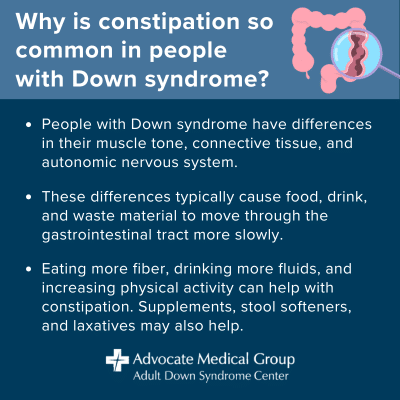
Contributing factors to the increase in constipation in people with Down syndrome include differences in:
- the muscle tone in the colon and abdominal wall
- the autonomic nervous system (the part of the nervous system that works automatically)
- the connective tissue (the tissue that provides the structure of the intestines and other body organs)
These factors affect motility (movement) of the gastrointestinal (GI) tracts of people with Down syndrome. Food, drink, and waste materials move through the GI tract differently (typically slower) in people with Down syndrome. One study found that 36% of children with Down syndrome had “functional “constipation. Functional constipation is constipation without an identifiable physical cause and, therefore, is typically related to motility.
Other medical conditions that are more common in people with Down syndrome can also contribute to constipation. Hypothyroidism and celiac disease are two examples. Some individuals have irritable bowel syndrome for which constipation may be a symptom.
Additionally, some individuals with (and without) Down syndrome have inactive lifestyles, eat diets low in fiber, take medication that has constipation as a side effect, and/or don’t drink enough fluids. All of these can contribute to constipation.
One situation that is sometimes noted is that constipation may develops in young adults with Down syndrome who are living independently or semi-independently for the first time. When they were younger, their parents probably made sure they ate food with fiber, drank enough water, and got some exercise. Once they’re on their own, however, it is sometimes noted that they may eat unhealthier foods, avoid fruits and vegetables, get less exercise, and drink less fluids. Instruction and guidance on healthier lifestyle habits can address this issue.
Symptoms
Some people with Down syndrome have difficulty communicating symptoms related to constipation and a behavior change may be the only symptom readily identified.
Additionally, constipation can be missed at times despite a person having regular bowel movements that appear loose and easy to pass. These softer stools may be moving past hard stool lodged in the rectum.
It can be challenging for parents or caregivers to recognize constipation in a person with Down syndrome who is independent in the bathroom. If there is any concern about constipation in those situations, it may be helpful to have the individual record their bowel movements on a chart. Particularly if constipation has been a serious problem in the past, a regular discreet review of the chart with parents or caregivers can help assure that the person is having regular bowel movements.
Diagnosis
A healthcare professional generally diagnoses constipation based on a good history and physical – in which the individual with Down syndrome is assessed for the symptoms and signs noted above. In more severe cases of constipation, physical findings during the abdominal exam may include hardness of the abdomen, palpable stool in the abdomen, bloating, or discomfort.
When constipation is more severe or the diagnoses is uncertain, additional testing for constipation may include plain x-ray (without barium), barium x-ray (barium enema), a computed tomography (CT) scan and/or colonoscopy (a scope passed into the rectum to view the large intestine). Colonoscopies generally require sedation or general anesthesia in people with Down syndrome.
Prevention and treatment
Lifestyle
The following are ways that may help improve motility and prevent or reduce constipation:
- Increase fiber in the diet.
- Fiber increases the “bulk” of the stool and softens it, making it easier to pass.
- Dietary sources of fiber include whole grains, fruit, and vegetables.
- It is best to increase fiber intake gradually to avoid bloating and abdominal pain.
- Increase fluid consumption.
- Dehydration contributes to constipation.
- Many people with Down syndrome do not drink enough water. Information on promoting a healthy intake of fluids is available in the Resources section below.
- Exercise regularly.
- Eat foods containing probiotics.
- Probiotics are foods or supplements that contain live microorganisms (bacteria). Some people report improved bowel movements with eating foods with probiotics. Examples include yogurt and fermented foods.
Over-the-counter medications and supplements
Medications and supplements that may help include:
- Probiotics supplements
- Fiber supplements such as psyllium (Metamucil) or wheat dextrin (Benefiber)
- Stool softeners or emollient laxatives such as docusate sodium (Colace)
- Cause stool to absorb more water and reduce dryness.
- Osmotic laxatives such as polyethylene glycol (Miralax)
- Draw water into the colon.
- Stimulant laxatives such as bisacodyl (Dulcolax)
- Can be taken as pills, suppositories, or enemas (Fleets)
- Tap water enemas
- Involves using an enema bag or bottle to gently insert water into the rectum to soften stool.
- Combination laxatives such as Senekot-S that contain a stimulant (senna) and a stool softener (docusate sodium)
The time between taking the medication or supplement and passing a bowel movement varies for each individual and on which treatment is used. Enemas and suppositories may have effect within minutes to hours while fiber supplements often take a day or two. The other treatments are often effective in a day or so (but not always or for all people).
Over-the-counter laxatives such as docusate sodium (Colace) and polyethylene glycol (Miralax) are usually not recommended on an ongoing basis. Over time, the body may become dependent on the laxative and the person may need to take it to continue to have bowel movements. However, in some individuals, regular use of medications seems to be the only solution.
While these medications can be found in grocery stores and pharmacies, higher doses may require a prescription from a health care professional.
Treatment from a health care professional
Sometimes, long-term constipation can lead to a cycle in which the person has painful bowel movements causing the person to hold back from having a bowel movement to avoid the pain. This usually results in even more constipation. In this situation, the symptoms often include diarrhea (liquid stool leaks around a large amount of constipated stool), a complete lack of stools, or stool incontinence (accidents). Encopresis is the name for the condition in which severe constipation and holding stools causes stool incontinence and/or diarrhea.
An aggressive management plan is needed to eliminate the stool that is causing discomfort. This usually requires some of the medications listed above. There will often be a period of time with diarrhea and possible stool incontinence as the large amount of stool is expelled. Once the large amount of stool has been removed, the person will need a maintenance plan to prevent accumulation of stool.
Treatment for anxiety may also be necessary. People with Down syndrome often have excellent visual memories. They may replay past events (such as painful bowel movements) over and over in their heads. Consequently, each time they approach a toilet, they may re-experience the pain and discomfort. This may then trigger a pattern of anxiety and avoidance of having a bowel movement. Additional information about visual memory and anxiety is available in Chapter 6 and Chapter 18 of Mental Wellness of Adults with Down Syndrome.
The upside to strong visual memories is that they can be used to learn healthier habits to reduce constipation. Use of visuals can be very advantageous when learning these habits. Examples are included in the Resources section below.
Resources
Down Syndrome
Gastroesophageal Reflux Disease
General
Constipation (Cleveland Clinic)
Encopresis (Stanford Medicine)
Fecal Impaction (Cleveland Clinic)
References
Ciciora SL, Manickam K, Saps M. Disorders of gut-brain interaction in a national cohort of children with Down syndrome. J Neurogastroenterol Motil. 2023;29(1):94-101. doi:10.5056/jnm22055
Join our mailing list
Sign up to receive emails with information on health topics for teens and adults with Down syndrome, updates on research and education as well as information about upcoming events, classes and programs.