
Key Points
- Swallowing is a complex function that consists of some steps that require us to think about them and other steps that do not require us to think about them.
- Normal swallowing of food and drink involves the nervous system, the muscles, and the anatomy of the tissue along the path that food takes from the mouth to the stomach. Changes or differences in these can contribute to abnormal swallowing.
- People with Down syndrome more frequently have differences in function and/or structure of the parts of the body involved in swallowing.
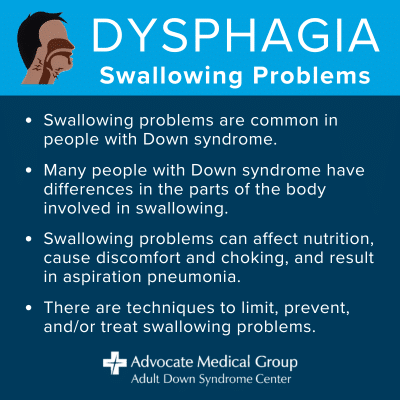
- Dysphagia (difficulty swallowing) can affect nutrition, cause discomfort and choking, and result in aspiration pneumonia.
- There are techniques to limit, prevent, and/or treat swallowing problems.
Swallowing function
Swallowing is a complex function. There are parts of swallowing that require us to actively think about them, including how big a bite or drink we take, how rapidly we eat or drink, how well we chew, etc. There are other parts of swallowing that occur without our conscious thought.
The autonomic nervous system manages much of our swallowing. It is part of the nervous system that acts automatically without us having to think about it. When we swallow, the nervous system:
- instructs the muscles to propel food downward from the mouth,
- closes our epiglottis (the flap that covers the windpipe when we swallow) so food does not pass into our lungs,
- pushes food and drink through the esophagus,
- opens the sphincter muscle at the junction between the esophagus and stomach to allow food to pass into the stomach, and
- closes the sphincter when the food has passed.
Impaired function in any of the steps noted above can cause swallowing problems. The medical term for when a person has difficulty or impaired swallowing is dysphagia.
Dysphagia and Down syndrome
Swallowing problems are common in people with Down syndrome. In our large cohort study that reviewed health data from people cared for within Advocate Health, swallowing problems were more than 6 times more common in people with Down syndrome compared to people without Down syndrome.
Pneumonia due to aspirating food, liquid, or one’s own saliva, called aspiration pneumonia, is one of the complications of swallowing dysfunction. In people with Down syndrome who develop Alzheimer’s disease, swallowing function can become impaired and recurrent pneumonias can become a serious health problem.
Location
One way to think about swallowing problems is by where the problem lies:
- Oropharyngeal – mouth, throat, upper airway
- Esophageal – esophagus (the tubular structure between the mouth and stomach)
- Esophagogastric – at the junction between the esophagus and stomach (gastroesophageal junction)
- Paraesophageal – the area in the chest outside the esophagus
People with Down syndrome have differences in the function and/or structure of several parts of the body involved in swallowing including the autonomic nervous system, smooth muscle, and connective tissue. Smooth muscle lines the gastrointestinal system and pushes food through the system. Connective tissue “holds us together” and defines the structure of organs. These differences can result in:
- Decreased propulsion of food and liquid through the gastrointestinal system, which can cause food and liquid to:
- Spill into areas they are not supposed to go (such as the lungs)
- Go backwards in the gastrointestinal tract (such as occurs with gastroesophageal reflux or heartburn)
- Not move forward in a timely fashion causing discomfort
- Problems in the oropharyngeal area, the esophagus, and the junction between the esophagus and stomach
- Abnormalities in the chest (e.g., enlarged heart) that compress the esophagus causing dysfunction (although this is not as common as the problems above)
Cause
Another way to think about swallowing dysfunction is by the cause.
Structural causes
Structural or physical abnormalities can affect swallowing.
Obstructions
Some examples of obstructions that are more common in people with Down syndrome include:
- Large tonsils
- Large thyroid gland
- Structurally smaller passageways (e.g., mouth, throat)
- Narrowing of the esophagus due to scarring caused by chronic acid reflux
- Upper airway/throat compression caused by significant atlantoaxial instability (AAI) or bony protuberances on the spinal column due to osteoarthritis (this is a rare problem)
Motor function
Abnormalities in the nervous system and/or muscles involved in swallowing can cause changes in motility (the movement of food and liquid through the gastrointestinal tract) and the function of the protective structures. Examples that are more common in people with Down syndrome include:
- Decreased function or uncoordinated function of the epiglottis which can cause food to pass into the lungs instead of the esophagus.
- Slow movement of food all along the passageway (this can be a problem throughout the gastrointestinal tract, from mouth to anus, in people with Down syndrome).
- Reduced function of the gastroesophageal sphincter which can allow food to pass backward up into the esophagus from the stomach. This is called gastroesophageal reflux disease or GERD.
- Food getting “hung up” in the throat causing gagging or choking (this can be caused by the slow movement and also obstructions noted above).
- Impaired function of the gastroesophageal sphincter such that it does not open correctly to allow food to pass into the esophagus.
- This can be caused by conditions such as achalasia, which is more common in people with Down syndrome compared to people without Down syndrome. In achalasia, the sphincter may not open correctly, parts of the esophagus may not contract well, and parts of the esophagus may have increased contractions. Achalasia can cause food to pass poorly through the esophagus, reflux of food and liquids back up into the throat, a choking sensation, and poor nutrition due to reduced ability to eat and absorb food appropriately.
Functional causes
When there is no clear structural or motility abnormality, there may be a functional cause. In people with Down syndrome, eating “behaviors” are often a functional cause of swallowing difficulties. These behaviors include eating too fast, taking bites that are too big, not chewing food well, and not taking sips of fluid so food is too dry to swallow well.
Another type of functional swallowing problem sometimes seen in people with Down syndrome occurs after a physical problem that resulted in impaired swallowing. The symptoms may persist even after the physical problem resolves. For example, some individuals who had a choking episode become afraid of it happening again. They may decline to eat, limit the foods they will eat, or eat very slowly. Some individuals seem to develop obsessive-compulsive behaviors and become very resistant to eating. More information is available in this Eating Refusal article and in Chapter 16 of our Mental Wellness book.
Diagnosis and treatment
At-home treatments
As noted above, some swallowing issues are “behavioral.” The person may not chew adequately, may rush with eating, or may not drink fluids while eating to keep their throat moist. In those situations, encouraging the individual to slow down, chew the food more thoroughly, put the fork (or spoon) down between bites, and take a sip of fluid between bites can be helpful. We have a video and visuals in our Resource Library to support people with Down syndrome to slow down the rate of eating and promote better chewing.
As described above, some swallowing issues are related to motor dysfunction or structural (anatomical) issues. Often, these are relatively minor problems. They may be managed with the same measures for “behavioral” causes. In addition, other measures that may help some individuals include:
- Cutting food into smaller bites
- Moistening the food (with gravy or sauces)
- Using a cup that limits the amount of liquid that enters the mouth with each sip
- Using a straw or not using a straw (this varies from person to person)
- Avoiding foods that are difficult to chew
- Drinking liquids that are a little thicker (such as nectars)
Treatments from a health care professional
If there are still concerns about swallowing, a referral to a speech therapist may be recommended. Speech therapists are the specialists who assist individuals with swallowing problems. Susan Bertucci-Maratea, Speech Therapy, at Advocate Lutheran General Hospital, shared some thoughts about swallowing function and treatment for impaired swallowing:
“Speech pathologists serve adults with dysphagia (impaired swallowing). Symptoms may include coughing or choking on food or liquids, food sticking in the throat, ‘wet’ or gurgly voice, extended time required to eat, difficulty chewing or swallowing, reflux, malnutrition and/or history of pneumonia.
We generally begin by evaluating the patient’s swallowing with a video fluoroscopic swallow study (intake of barium and different food consistencies visualized by x-ray). Recommendations regarding appropriate food textures, swallowing strategies, and/or swallowing therapy are made after the swallow study.”
Our Resource Library has a swallow study visual, and University of Florida Health has a swallow study video that explain what happens during a swallow study.
Additional evaluation by an otolaryngologist (ENT) or gastroenterologist may also be needed to address findings on the swallow evaluation. Further evaluation of the mouth, throat, and esophagus with imaging (x-ray, CT scan, MRI) and/or scopes to visualize the areas may be indicated.
Assessment and treatment recommendations from a dietician may also be indicated if the person is experiencing nutritional deficits due to impaired swallowing and eating.
Join our mailing list
Sign up to receive emails with information on health topics for teens and adults with Down syndrome, updates on research and education as well as information about upcoming events, classes and programs.