
Helping a Person with Down Syndrome Prepare for a Hospital Stay
July 16, 2024
General Tips
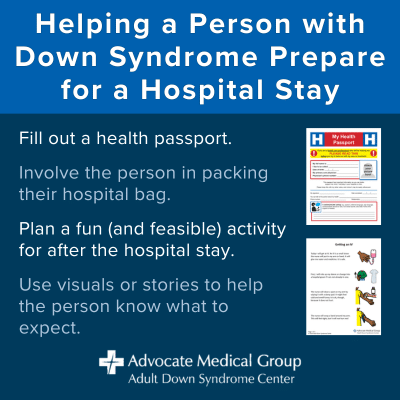
- Encourage the person with Down syndrome to complete a health passport.
- Health passports are documents that contain information such as health history, medications, communication preferences, how to help the person calm down, and other needs. They can be shared with the individual’s care team at the hospital, so they have easy access to this important information.
- Involve the person with Down syndrome in packing their hospital bag. Having the person pick out a favorite blanket, pillow, movie, music playlist, or other comfort item may give them a sense of control.
- Plan a fun (and feasible) activity to do after the hospital stay so the person with Down syndrome has something to look forward to.
- Use visuals or stories to help the person with Down syndrome understand what to expect during the hospital stay (getting admitted, changing into a hospital gown, getting an IV, etc.). Here are some examples:
Visuals for Medical Appointments (Adult Down Syndrome Center)
Includes visuals/stories about blood tests, IVs, x-rays, ultrasounds, electrocardiograms (EKGs), and electroencephalograms (EEGs).
Medical Procedure Photo Stories for Adults (Agency for Clinical Innovation)
Includes visuals/stories about blood tests, CT scans, operations, x-rays, and going to the hospital.
Visual Supports for Hospital and Doctor Visits (Pathfinders for Autism)
Includes visuals for common hospital terms, pain scales, identifying where on the body someone feels pain, and asking for help.
- Use role play to practice various aspects of the hospital stay. For example, for a blood draw, you could wipe the person’s arm with an alcohol pad, pretend to do the blood draw, and then put a bandage on the person’s arm. Practicing at home can help the person feel more comfortable and less anxious.
- If possible, visit the hospital before the stay. While hospital policies will likely prevent you from seeing some areas, the individual with Down syndrome may benefit from seeing the exterior of the building and public areas of the hospital. It may be helpful to contact the hospital’s Patient Services or Patient Relations Department.
Tips for Surgeries and Procedures
- Talk with the surgeon and anesthesiologist about what to expect. It may be helpful to include this information in visuals/stories.
- Will the person with Down syndrome need to do any special preparation (tests, medications, etc.)?
- When will the person with Down syndrome need to stop eating and drinking?
- What about medications?
- If the person takes daily medications, what medications can or should the person with Down syndrome take the day of the surgery?
- Would the person with Down syndrome benefit from taking a medication the day of surgery to help them relax?
- How soon after the surgery can a family member or friend be in the recovery room with the person with Down syndrome?
- People with Down syndrome often benefit from having a family member or friend in the recovery room as soon as possible after the surgery. That can reduce stress as the person awakens from anesthesia.
- Will the person with Down syndrome need to sit or lay in a specific position after the surgery or procedure?
- If the person with Down syndrome only sleeps in one position, it may be helpful to practice sleeping in other positions.
- If the surgeon recommends sleeping with a wedge, body pillow, etc., consider trying it out before surgery.
- Will the person with Down syndrome need to wear or use any medical equipment (e.g., drains, braces, walkers, etc.)?
- If possible, practice using the equipment.
- Will the person with Down syndrome have eating or drinking limitations after the surgery?
- Identify and purchase foods and beverages that the person enjoys and can eat.
- What activity limitations will the person with Down syndrome have after the surgery?
Join our mailing list
Sign up to receive emails with information on health topics for teens and adults with Down syndrome, updates on research and education as well as information about upcoming events, classes and programs.