
Overweight and obesity
The parent of an individual with Down syndrome asked a question about medications to treat obesity in a person who has not been significantly successful with diet and exercise despite many efforts. I have shared my response below.
Obesity and overweight as measured by body mass index (BMI) are more common in people with Down syndrome. BMI, the measurement commonly used to assess weight status, is a calculation based on height and weight. A score of 18.5 to 24.9 is considered normal, 25-29.9 is “overweight,” 30-34.9 is class 1 obesity, 35-39.9 is class 2 obesity, and 40 and above is class 3. However, there is ongoing study and discussion as to the accuracy of BMI as a measurement in people with Down syndrome as noted in an article called Assessing Down Syndrome BMI and Body Composition and another article called Body Composition and BMI Growth Charts in Children with Down Syndrome. For now, BMI is the measure commonly used.
For a person with Down syndrome, weight management can be as challenging or even more challenging than in others. An article called Weight Management in Adults with Down Syndrome in our Resource Library, summarizes some of the issues and approaches to weight management.
However, the difficulty of weight management and the frequent failure despite great effort have led to the exploration of other treatments.
Surgery
One study, Sleeve Gastrectomy for Youth With Cognitive Impairment or Developmental Disability, looked at weight loss (bariatric) surgery for adolescents. Eight of the participants had a cognitive impairment (CI) or developmental disability (DD) including three with Down syndrome. The study concluded: “Bariatric surgery may be a helpful tool for adolescents with severe obesity and CI/DD. They could benefit from the surgery as much as those with typical development and having CI/DD should not be used as a criterion to deny surgery.”
Medications
Unfortunately, we were not able to find a study (or studies) describing the use of weight loss medication in people with Down syndrome. There are several medications available for weight loss but the knowledge of their use in people with Down syndrome is limited.
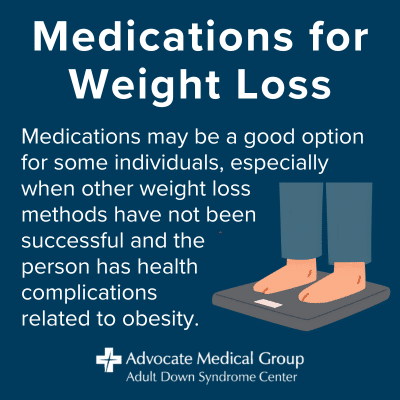
We have treated a small number of adults with Down syndrome with weight loss medication with some success. We think it is reasonable to consider medications for some individuals, especially when other methods have not been successful, particularly if they have health complications related to obesity. When the decision is made to consider a medication, a careful review of the medical history is warranted to help in the selection of the correct medication. The appropriate medication will vary from person to person. For example, some medications may be concerning for someone with gastrointestinal concerns, some for a person with history of anxiety, etc.
Below is a list of medications and their mechanisms of action as well as our experience and particular concern in Down syndrome.
Orlistat (Xenical, Alli)
- Reduces fat absorption.
- A small number of patients have tried it. Soiling and incontinence associated with use may make this particularly challenging to use in some people with Down syndrome.
Phentermine-topiramate (Qsymia)
- Phentermine is a stimulant and topiramate is a seizure medication. Cause of weight loss not known.
- A small number of patients have tried phentermine alone with some success. We have some experience with topiramate by itself as a weight loss medication and have seen some benefit when taken alone. Topiramate is not FDA-approved to use by itself as a weight loss medication. We have had difficulty getting the combination medication approved by insurance. One option is to get prescriptions for each medication separately and take them together. In our experience, we have seen some weight loss when taken together. They can cause mood changes, anxiety, and cognitive impairment. There are a variety of other stimulants available that can also be prescribed for weight loss.
Lisdexamfetamine (Vyvanse)
- One stimulant used for weight loss is lisdexamfetamine.
- This medication has an indication for binge eating disorder (moderate to severe).
- We have limited experience using this medication for weight loss. We do have patients who have used or are using it for attention-deficit/hyperactivity disorder who have noted the side benefit that it reduces their overeating.
Naltrexone-bupropion (Contrave)
- Naltrexone blocks opioid receptors (used to treat opioid and alcohol dependence and also used to treat self-injurious behavior (SIB) in people with intellectual disabilities). Bupropion (Wellbutrin) is an anti-depressant.
- A small number of patients have tried it with some success. It can be challenging to get it approved by insurance; an option is to prescribe each medication individually and take them together. We have more experience using each one separately for SIB or depression and find them to be well-tolerated separately and together (in more limited experience). Neither medication is FDA-approved to be used by itself for weight loss.
Semaglutide (Wegovy, Ozempic) and liraglutide (Saxenda)
- They activate the glucagon-like-peptide-1 (GLP-1) receptor in the brain, regulating appetite and caloric intake. This category of medications is also used to treat diabetes mellitus.
- These medications are becoming more available and there has been some increase in coverage by medical insurance. They are given via injection. Thyroid C-cell tumor is a possible side effect. Due to the limited, but improving, coverage by insurance, we have not had a lot of opportunity to prescribe these medications but have seen success with those who have been able to obtain it. A study assessing semaglutide, Once-Weekly Semaglutide in Adults with Overweight or Obesity, showed very significant weight loss; however, it has not been studied in people with Down syndrome.
Cellulose-citric acid hydrogel (Plenity)
- Mixes with ingested food to increase volume promoting sense of satiety and fullness.
- We have had no experience with it. Gastrointestinal side effects are common and likely to be limiting in people with Down syndrome (many of whom, in our experience, tend to have GI symptoms chronically).
Tirzepatide (Zepbound)
- Similar to semaglutide above, it activates glucagon-like peptide (GLP-1) but it also activates glucose-dependent insulinotropic polypeptide (GIP). This reduces appetite, slows emptying of food from the stomach, increases insulin secretion, reduces glucose (sugar) production in the liver, and improves fat metabolism.
- In our clinic’s experience, we have seen some individuals lose weight with this medication.
Individuals taking medications for appetite and weight loss need to be monitored closely. We recommend working with a physician or other health professional who is familiar with using weight loss medications and, if possible, also in caring for people with Down syndrome. A healthcare professional who is affiliated with a university medical system who specializes in weight management may be an option. A physician who is familiar with medications for weight will be aware of the contraindications.
One thing that is becoming clearer with the use of these medications is that they are treating a chronic condition. In the non-Down syndrome population, many people who achieve their weight goal and then stop the medication will have a rebound weight gain. It appears that use of the medication addresses the problem but not the underlying causes. Without significant lifestyle changes, stopping the medication will probably result in a weight increase again. Additionally, the beneficial effect of some of these medications on weight management may reduce (wear off) over time (even while still taking the medication).
Medications are best viewed as an adjunct to healthy eating and exercise activities. Building those healthy habits into the day can be a challenge for some individuals with Down syndrome (and some without Down syndrome). It has become clear that this is more than just “willpower” for most people, and there is much that needs to be learned of the brain chemistry, metabolism, etc. that contribute to weight management. This is even more true for people with Down syndrome as discussed in the weight management article from our Resource Library referenced above. However, some achieve and maintain their goals through a big commitment to change their nutrition and activity habits (which usually includes that others in the home do the same). It can be an upstream challenge in the face of societal and cultural norms for nutrition and activity.
Resources
Down syndrome
Exercise and Physical Activity (articles, visuals, and videos from our Resource Library)
Nutrition and Weight (articles, visuals, and videos from our Resource Library)
Addressing Unhealthy Eating Habits (podcast episode from the Down Syndrome Center of Western Pennsylvania)
Weight Loss Medications and Surgeries (podcast episode from the Down Syndrome Center of Western Pennsylvania)
Webinars from the Down Syndrome Medical Interest Group-USA on Treatment Strategies and Recommendations for the Management of Overweight and Obesity
Diet and Nutrition Care Interventions
Physical Activity and Exercise Benefits and Recommendations
Pharmacotherapy and Surgical Options
General
Prescription Weight-Loss Drugs (Mayo Clinic)
Top Weight Loss Medications (Obesity Medicine Association)
Originally shared July 12, 2022
This article was adapted from a Q&A developed in partnership with LuMind IDSC Foundation.
Join our mailing list
Sign up to receive emails with information on health topics for teens and adults with Down syndrome, updates on research and education as well as information about upcoming events, classes and programs.