
Selective Mutism and Other Causes of Loss of Speech in Adults with Down Syndrome
June 26, 2026
Key points
- Selective mutism is when a person can speak normally in some places but cannot speak in certain settings or with certain people. It is an anxiety-related condition that is often associated with social anxiety.
- Selective mutism is more common in people with Down syndrome than in people without Down syndrome.
- Some people with Down syndrome develop a more general loss of speech, meaning they speak less or not at all in many or most settings.
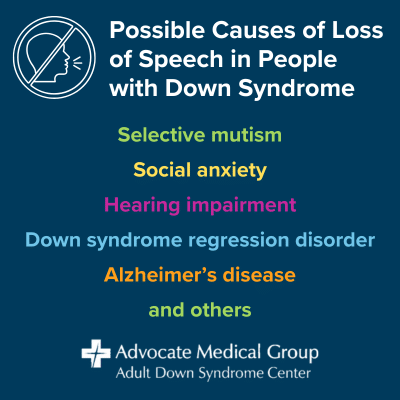
- Changes in speech may have many possible causes, including anxiety, hearing loss, trauma, depression, catatonia, Down syndrome regression disorder, Alzheimer’s disease, autism, or other medical or neurological conditions.
- There are many treatment approaches for selective mutism including therapies, medicines, supplements, family support, and lifestyle changes.
What is selective mutism?
Selective mutism is an anxiety condition in which a person who can speak normally is unable to speak in certain situations. For example, someone may talk freely at home but not speak at school, at the doctor’s office, or around unfamiliar people. Selective mutism is often associated with social anxiety.
Selective mutism is different from a total loss of speech. In selective mutism, the person is able to speak in some places or with some people, but anxiety makes speaking very difficult in other situations.
Selective mutism is most often discussed in children, but it can also occur in adults.
What is generalized loss of speech?
Some people stop speaking in many or even all settings. This is different from selective mutism.
A more general loss of speech can happen for psychological, neurological, or physical reasons. It may be temporary or long-lasting.
Some examples of possible causes include:
- Trauma, such as abuse
- Catatonia
- Depression
- Strokes
- Other neurological disorders
- Injury or disease of the larynx (voice box)
Other ways speech changes may appear
Speech changes can present in other ways. Some people may:
- Only whisper
- Speak very softly
- Talk much less than usual
- Speak only to a few trusted people
Why is this important in people with Down syndrome?
People with Down syndrome can have a variety of speech changes just like people without Down syndrome. However, speech changes may be especially important to notice in people with Down syndrome for several reasons.
Selective mutism is more common in people with Down syndrome.
A review of multiple studies reported that selective mutism occurs in about 6% of people with Down syndrome (Edwards, 2022). In comparison, the American Speech-Language-Hearing Association reports rates of up to 1.6% in people without Down syndrome.
People with Down syndrome may have other speech and language challenges.
Expressive language is the ability to verbalize, write, and use gestures to communicate. Receptive language is the ability to understand words and language.
Many people with Down syndrome have some degree of difficulty with expressive language. Their expressive language skills tend to be less developed than those of people without Down syndrome.
Many people with Down syndrome understand more than they can express. They have stronger receptive language skills than expressive language skills
Behavior change may be a form of communication.
The difficulties with expressive language that many people with Down syndrome have can make it more challenging to verbalize feelings of anxiety or stress. Many people with Down syndrome communicate their anxiety or stress (physical, mental, and social) with a behavioral change. Speaking less or not speaking can be one of the behavioral changes.
There may be more than one cause.
A speech change may be related to anxiety, but it may also involve one or more other physical, mental, or social stressors.
The effects of social pressure
Not every person with Down syndrome who stops talking in a certain situation has selective mutism. Sometimes, a speech change is a learned behavior in response to pressure or discomfort.
For example, a person with Down syndrome may speak at home or in most social settings but not speak at a doctor’s appointment. This may happen because:
- The questions feel difficult.
- The person feels rushed.
- They worry they will not be understood.
- They have learned that someone else (such as a parent or caregiver) will answer for them.
In these situations, the person may be trying to avoid stress or discomfort rather than experiencing classic selective mutism.
Strategies that may help include:
- Reassurance
- Simple language
- Visual supports
- Extra time to respond
- Asking only a few questions at first
- Allowing parents or caregivers to help when needed
These strategies can reduce pressure and make speaking feel safer.
Social anxiety disorder
Another possible explanation is social anxiety disorder, which is a common type of anxiety. A person with social anxiety disorder feels symptoms of anxiety or fear in some or all social situations.
A person can have both social anxiety and selective mutism. In the doctor’s office example above, the person with Down syndrome may have social anxiety due to feeling they are not able to answer the questions appropriately. Since the symptoms include not speaking, the person may also have selective mutism. According to the SMart Center, an estimated 90% of children without an intellectual disability who have selective mutism also have social anxiety.
Other causes of loss of speech in people with Down syndrome
Many conditions that affect physical, mental, or social health can also affect speech in people with Down syndrome.
Hearing problems
Hearing impairment can contribute to a change in speech. To assess hearing and identify potential causes of hearing impairment, a person may need:
- A physical exam
- A hearing screening
- An evaluation by an audiologist
- An assessment by an ear, nose, and throat specialist (ENT, otolaryngologist)
Obsessional slowness
Some people with Down syndrome develop a pattern sometimes called obsessional slowness – they move very slowly in many, most, or even all aspects of their life. They often have significant compulsive behavior such as repetitive rituals. Lack of speaking or only whispering are also common symptoms. In our experience, the changes in speech tend to occur in many or all settings rather than selectively.
In people without an intellectual disability, some health professionals and researchers recommend against the term “obsessional slowness.” Instead, some recommend just including it as a symptom of obsessive-compulsive disorder. Similarly, the use of the term “obsessive slowness” should be further discussed for people with Down syndrome, but the term is very descriptive of the behavior seen in a small number of the individuals with Down syndrome we have seen at our clinic.
Down syndrome regression disorder
Some people with Down syndrome who develop Down syndrome regression disorder (DSRD) have decreased speech.
Catatonia may be a symptom of DSRD. Some individuals with catatonia will only whisper or do not talk at all.
One difference between DSRD and obsessional slowness is that people with DSRD lose the ability to do some skills while people with obsessional slowness commonly can still do a skill but do not do it or do it exceedingly slowly.
Alzheimer’s disease
Older adults with Down syndrome who develop Alzheimer’s disease usually have a decline in speech and communication at some point in the course of the disease.
Autism
Autism can affect speech and language. Autism is more common in people with Down syndrome. However, autism symptoms begin in childhood, as is the case in people without Down syndrome.
Mental health conditions
In addition to anxiety, speech loss may occur because of trauma, depression, or other mental health conditions.
Evaluation
A person with Down syndrome who suddenly speaks less, whispers more, or stops speaking should be evaluated. A good evaluation should review physical health (e.g., hearing impairment, injury to the throat), mental health, social stressors, and recent life events.
Treatment for selective mutism
People with Down syndrome and selective mutism may require support from more than one professional such as:
- A psychologist or other mental health professional
- A speech-language pathologist
- A physician or other medical professional to prescribe medications
Treatments for anxiety are recommended. These would include cognitive behavioral therapy, counseling, and anti-anxiety medications such as selective serotonin reuptake inhibitors (sertraline, paroxetine, etc.).
Specific approaches or strategies that may be used include:
- Psychoeducation
- Mindfulness/relaxation exercises
- Coping strategies
- Exposure-based approaches
- Stimulus fading: The person starts in a comfortable setting with someone they already talk to. Then a new person (someone they have difficulty talking to) is slowly added.
- Shaping: The person is praised for all efforts to communicate, such as pointing, nodding, whispering, or using a few words. The goal is to build toward spoken speech.
- Self-modeling
- The person watches videos of themselves speaking successfully in a comfortable setting. This may help build confidence and encourage this behavior in settings where they do not speak.
Modifications for a person with Down syndrome may include visuals and stories, repetition, using simpler language, and including family or caregivers in treatment.
In our experience, several people with Down syndrome required time as a significant part of their healing. They slowly began to speak again as the fear or anxiety that contributed to the start of their selective mutism decreased with time.
Other approaches that may support anxiety treatment
Healthy lifestyle choices may help some people with anxiety, although they are not as well studied in people with Down syndrome.
- Regular exercise
- Eating balanced meals
- Including protein in your breakfast
- Eating complex carbohydrates (may increase serotonin in the brain)
- Drinking plenty of water
- Limiting or avoiding caffeine and alcohol
- Noticing foods that seem to worsen symptoms
Supplements may also be considered.
- Magnesium
- Valerian root
- B vitamins
- Omega-3 fatty acids
- L-theanine
- Chamomile tea
Because supplements can have side effects or interact with medications, they should be discussed with a healthcare professional before use.
Resources
Down syndrome
Mental Wellness in Adults with Down Syndrome (Chapter 18 is on anxiety)
Regression & Down Syndrome (National Down Syndrome Society)
Selective Mutism Podcast Episode (Down Syndrome Resource Foundation)
General
Coping with Anxiety: Can Diet Make a Difference? (Mayo Clinic)
Selective Mutism (American Speech-Language-Hearing Association)
Social Anxiety Disorder (National Institute of Mental Health)
What is Selective Mutism? (SMart Center)
References
Edwards G, Jones C, Pearson E, et al. Prevalence of anxiety symptomatology and diagnosis in syndromic intellectual disability: A systematic review and meta-analysis. Neurosci Biobehav Rev. 2022;138:104719. doi:10.1016/j.neubiorev.2022.104719
Fodstad JC, Jones LB, Iticovici M, Russell RM, Bullington M, Meudt E. The state of anxiety treatments for adolescents and adults down syndrome: Results from a scoping rapid review. J Mood Anxiety Disord. 2024;6:100056. doi:10.1016/j.xjmad.2024.100056
Martin GE, Klusek J, Estigarribia B, Roberts JE. Language characteristics of individuals with Down syndrome. Top Lang Disord. 2009;29(2):112-132. doi:10.1097/tld.0b013e3181a71fe1
Mevissen L, de Jongh A. PTSD and its treatment in people with intellectual disabilities: A review of the literature. Clin Psychol Rev. 2010;30(3):308-316. doi:10.1016/j.cpr.2009.12.005
Join our mailing list
Sign up to receive emails with information on health topics for teens and adults with Down syndrome, updates on research and education as well as information about upcoming events, classes and programs.