
Hunger and Satiety in People with Down Syndrome
October 7, 2019
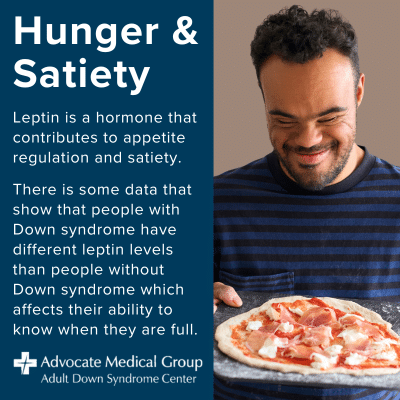
Leptin is a hormone that contributes to appetite regulation and satiety. There is some data that show that individuals with Down syndrome have increased leptin levels which correlates with higher rates of obesity. This is consistent with reports of family members and caregivers who have shared that their loved ones with Down syndrome never seem to get full.
Monitoring and managing portion sizes may help individuals with Down syndrome reach or maintain a healthy weight. Some tips are listed below.
- Start with smaller portion sizes. Put less food on your plate so you are not tempted to eat too much.
- Use smaller plates so that the same amount of food takes up more space on the plate.
- Consider buying plates that are divided into section for the different food types (protein, grains, fruits/veggies, etc.). This encourages us to eat a well-balanced meal with a variety of foods.
- Avoid family-style dining. Instead, fill plates and then bring them to the table.
- Eat meals in stages. Start with a larger portion of vegetables. Then move on to proteins and grains.
- Consider buying snacks that are pre-packaged in individual portions. Alternatively, take a serving of a snack and then put the larger container away to avoid overeating.
- When dining at restaurants, ask for a box when you get your food so you can split your meal in half and bring leftovers home.
- Encourage a slower pace of eating. Eating too fast limits the body’s ability to signal to the brain that we have eaten enough.
Additional tips are described in this article on weight management in adults with Down syndrome from our Resource Library.
References
Join our mailing list
Sign up to receive emails with information on health topics for teens and adults with Down syndrome, updates on research and education as well as information about upcoming events, classes and programs.