
Elevated Globulin in People with Down Syndrome
February 13, 2026
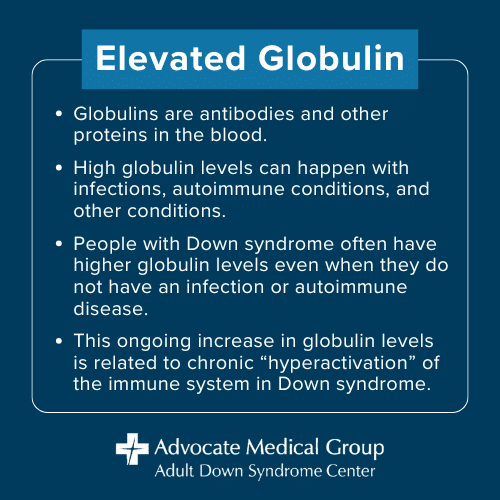
Key Points
- Globulins are antibodies (also called immunoglobulins) and other proteins in the blood. A globulin level is often checked in routine blood tests.
- High globulin levels can happen with infections, autoimmune conditions (like celiac disease or type 1 diabetes), and other conditions.
- People with Down syndrome often have higher globulin levels even when they do not have an infection or autoimmune disease.
- This ongoing increase in globulin levels is related to chronic “hyperactivation” of the immune system in Down syndrome. This overactivity increases the risk for infections, autoimmune diseases, and some other health conditions.
What is an elevated globulin level?
Globulins are antibodies (also called immunoglobulins) and other proteins in the blood that help the immune system function. A blood test can measure globulin levels. A high globulin level usually means the body is fighting inflammation, which can be caused by:
- Infections
- Autoimmune diseases (when the immune system attacks the body’s own tissues)
- Some cancers
The globulin blood test is commonly included in a chemistry panel ordered during regular health checkups.
Why are elevated globulin levels important in Down syndrome?
People with Down syndrome often have higher levels of globulins for several reasons:
Infections
Many infections – either short-term (acute) or long-term (chronic) – can raise the globulin level. People with Down syndrome are more likely to get infections for a variety of reasons including impaired immune function.
Autoimmune diseases
Autoimmune diseases can raise globulin levels and are more common in people with Down syndrome. Examples include:
Cancer
Some cancers can raise globulin levels. Multiple myeloma is a blood cancer that can cause elevated globulin levels. It is more common in people with Down syndrome.
Leukemia is another form of blood cancer that is more common in children with Down syndrome. However, leukemia usually causes low, not high, globulin levels.
Liver disease
Certain liver diseases can raise globulin levels. One example is metabolic dysfunction-associated steatotic liver disease (MASLD), which is more common in people with Down syndrome.
Chronic inflammation
People with Down syndrome tend to have hyperactivation (increased activity) of their immune system. This can cause:
This overactive immune system can raise globulin levels even when no illness is present. If a new condition develops, levels may rise even higher.
How do we evaluate an elevated globulin level?
If a blood test shows elevated globulins, it is important to check for the conditions listed above such as infections, autoimmune conditions, multiple myeloma, and others. If none of these conditions are found, the elevated globulin may be due to the chronic inflammation commonly seen in Down syndrome. In that case, we typically do the following:
- Document the elevated level
- Continue routine monitoring
- Watch for signs that a new condition might be developing
There are different types of globulins (such as IgG, IgA, and others). A blood test called immunoglobulin electrophoresis may be ordered to look at these subtypes more closely.
What is IVIG (intravenous immunoglobulin)?
You may hear the terms “immunoglobulin” or “IVIG” in discussions about health conditions in people with Down syndrome, especially in relation to Down syndrome regression disorder (DSRD).
IVIG is a treatment given through an IV (intravenous catheter). It is made from IgG antibodies collected from thousands of healthy blood donors. IVIG works by modulating (balancing) the immune system to reduce abnormal inflammation, which can help in certain conditions such as DSRD for some individuals.
Resources
Metabolic Dysfunction-Associated Steatotic Liver Disease (MASLD)
Regression (National Down Syndrome Society)
References
Buckman MA, Vasileva A, Jedlicka CR, et al. Cancer and post-therapy cardiotoxicity risk in adolescents, young adults, and adults with Down syndrome. Compr Physiol. 2025;15(5):e70037. doi:10.1002/cph4.70037
Waugh KA, Minter R, Baxter J, et al. Triplication of the interferon receptor locus contributes to hallmarks of Down syndrome in a mouse model. Nat Genet. 2023;55(6):1034-1047. doi:10.1038/s41588-023-01399-7
Join our mailing list
Sign up to receive emails with information on health topics for teens and adults with Down syndrome, updates on research and education as well as information about upcoming events, classes and programs.