
Gait or Walking Changes in a Person with Down Syndrome
January 10, 2024
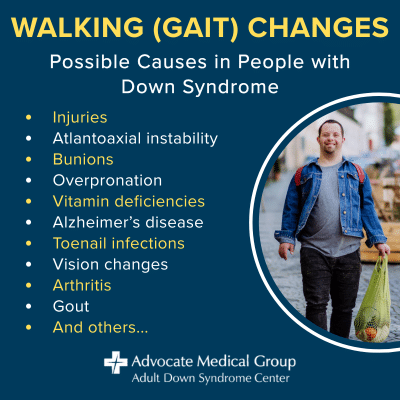
Key Points
- A change in gait (walking) is a change seen in many people with Down syndrome.
- There are many possible causes for those changes.
- Family or other observers can play a critical role in assessing and treating these changes since some people with Down syndrome have difficulty verbally expressing their symptoms.
- A thorough evaluation including a history and physical by a health care professional is important to assess and treat the change. Additional studies (labs, x-rays, etc.) and referrals to other health care professionals may be indicated based on the initial evaluation.
What can cause a change in gait?
Injuries
Acute illness
Orthopedic causes
Subluxation of the spine
Subluxation of the spine occurs when the bones in the spine (vertebrae) slip out of position (subluxation). The spinal canal can become narrowed, and the spinal cord can be pinched. The most common joint in the spine in which slippage can occur is the joint between the first and second vertebrae in the neck (cervical spine). This is called atlantoaxial instability (AAI) or atlantoaxial subluxation. Additional symptoms may include urinary and/or stool incontinence (bowel or bladder accidents), weakness of the arms, dropping objects, neck or back pain, or numbness. AAI is more common in people with Down syndrome.
Spinal cord stenosis
Bony changes in the vertebrae due to arthritis may also cause narrowing of the spinal canal causing the spinal cord to get pinched.
Ligamentous laxity
Ligaments are bands of fibrous tissue that connect our bones to each other. In people with Down syndrome, these ligaments tend to be “looser” causing some joint instability (looseness). This is called ligamentous laxity. AAI noted above is an example of ligamentous laxity, but it may also occur in any joint in the body. Where the kneecap (patella) attaches to the thigh bone (femur) is one joint where this is more common in people with Down syndrome. If the kneecap does not stay in normal alignment, it can affect the gait either by causing pain or altering the mechanics of walking.
Bunions
A bunion (also called hallux valgus) is a bony projection or bump that forms at the base of the big toe. Joint laxity contributes to bunions. They can cause gait change due to discomfort or, if the joint is significantly deformed, can alter the mechanics of foot function.
Flat feet and overpronation
Overpronation is a condition in which the foot tends to roll-over too far towards the inside of the foot with walking. It is often associated with flat feet. This can cause a gait change because of pain or by altering the mechanics of walking.
Arthralgia or arthritis
Arthralgia is pain in a joint. Arthritis is a health condition in which there is inflammation in a joint or joints and is usually also associated with joint pain. Osteoarthritis (or similarly osteoarthrosis) is a condition that occurs when the protective cartilage the cushions the end of bones is worn down. This is a degenerative condition, the joints develop “wear and tear” over time. Osteoarthritis may be more common in people with Down syndrome because laxity of joints can predispose to osteoarthritis.
Inflammatory arthritis
Inflammatory arthritis is caused by abnormalities that cause inflammation in the joint. It is also more common in people with Down syndrome. Autoimmune conditions (conditions in which one’s own immune system attacks a particular part or parts of the body) are more common in people with Down syndrome. Arthritis due to autoimmune conditions is more common in people with Down syndrome. There are several types of arthritis due to autoimmune, inflammatory conditions that can affect people with Down syndrome. One type is called Down syndrome-associated arthritis.
Gout
Skin conditions
Dry skin
Painful, cracked skin on the soles of the feet can cause a gait change. Dry skin is more common in people with DS and the feet are a common area that can become quite dry and cause discomfort.
Skin or nail infections
Venous disease
Changes in the groin area
Vision changes
Dizziness
Vitamins and minerals
Metabolic changes
Alzheimer’s disease
Down syndrome regression disorder
Psychological conditions
Seizures
Chronic pain
Any chronic painful condition can contribute to a change in walking.
Diagnosis
As noted, some people with Down syndrome are not able to report changes in their symptoms. Therefore, the diagnostic process may have to start with others observing changes in gait and other symptoms. A health care professional should do a thorough history and physical exam that assesses the change in gait and also the broad range of symptoms that may accompany the gait change.
Possible diagnostic tests based on the history and physical exam:
- X-rays, computerized tomography (CT) scan, and/or magnetic resonance imaging (MRI) scan of the spine
- X-rays of a joint that appears to have significant joint laxity
- X-rays to assess for arthritis changes
- Blood work (labs) to assess for abnormalities that indicate that it may be inflammatory arthritis and to help diagnose the specific cause
- Blood testing to assess for vitamin, mineral, and/or metabolic abnormalities
- A joint aspiration in which a needle is inserted into a joint and fluid collected to be analyzed in the lab
- An assessment by an ear, nose, and throat doctor (otolaryngologist) to assess the inner ear
- Doppler (ultrasound) study of the veins
- Vision exam by an ophthalmologist or optometrist
Treatment
Treatment should be directed based on the findings of the history and physical and additional studies to address the specific cause. A variety of resources are available in our online Resource Library that discuss treatment for specific conditions.
Change in gait in people with Down syndrome and Alzheimer’s disease
Many people with Down syndrome who have Alzheimer disease develop gait dysfunction (difficulty walking). Early on, the person may express or display fears of walking before any actual loss of walking skills is noted. Many people seem to have both an impairment in gait and depth perception. Some people first become fearful in situations where there is more of a need to use depth perception. Situations where this may occur include:
- Stairs or escalators, especially those that are not enclosed or next to a wall
- Changing from one surface to another
- Glass elevators
- Buildings (often shopping malls) with glass railings overlooking an opening down to the next level
Many people with Down syndrome who don’t have Alzheimer’s disease have mild impairments in walking and depth perception. Worsening of these issues can be a sign that the person is developing Alzheimer’s disease. As difficulties with gait and depth perception worsen, symptoms and signs may include:
- Leaning to one side or the other (sometimes even when sitting)
- Needing increased assistance to walk
- Walking more slowly
- Falling
- Sitting down when trying to walk longer distances
Evaluation and treatment may include:
- Encouraging the person to keep walking to maintain skills as long as possible
- Having someone nearby to prevent falls
- Assessing the individual for other causes (as discussed above) that the person could have in addition to Alzheimer’s disease
- Referring the person for a physical and/or occupational therapy assessment for guidance in optimizing walking skills and to evaluate for and train the person in using assistive devices such as a cane or walker. We should note that, in our experience, most people with Down syndrome who are developing Alzheimer’s disease struggle to use assistive devices correctly. The device may end up being more harmful than beneficial because it can cause the person to trip and fall.
- Using a wheelchair for longer distances
Join our mailing list
Sign up to receive emails with information on health topics for teens and adults with Down syndrome, updates on research and education as well as information about upcoming events, classes and programs.