
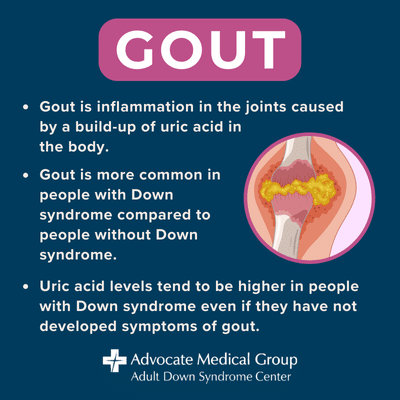
Key Points
- Gout is caused by build-up of uric acid in the body which can cause inflammation in the joints (inflammatory arthritis).
- An acute “attack” of gout can be very painful. Attacks may occur recurrently.
- Gout is more common in people with Down syndrome.
- Uric acid levels tend to be higher in people with Down syndrome even if they have not developed symptoms of gout.
- Treatments are available to stop an acute attack and to prevent recurrences.
- In addition to gout, elevated uric acid may contribute to other health conditions.
What is gout?
Gout is a type of inflammatory arthritis caused by a build-up of uric acid in the body. People who experience gout typically have an elevated amount of uric acid in their blood.
When uric acid builds up, urate crystals can form. The urate crystals can cause the body to have an inflammatory response. This commonly occurs in joints, often in the joint at the base of the big toe, and can cause swelling in and around the joint, redness, and pain. The pain can be quite intense and can last for several days or even weeks. Uric acid can also deposit in the skin, in the kidneys, and in other organs. It can cause pain underneath the skin and can cause kidney stones.
Gout is more common in people with Down syndrome. Even if they do not have symptoms of gout, people with Down syndrome more frequently have elevated amounts of uric acid in their blood.
Diagnosis
Gout can be diagnosed by collecting fluid from the joint using a needle. The fluid is sent to a lab to look for urate crystals. Pseudogout or calcium pyrophosphate deposition is another condition that has similar symptoms as gout. However, in this condition, when fluid is collected and analyzed, it contains calcium pyrophosphate instead of urate crystals.
Sometimes, a medical decision is made to not perform the procedure to collect fluid since it may be difficult for some people with Down syndrome to tolerate having a needle put in the joint to collect the fluid. They may require sedation or anesthesia to collect the sample. The diagnosis of gout may be presumed based on the symptoms and elevated uric acid levels detected through a blood test.
It is possible that sometimes gout may be incorrectly diagnosed in a person with Down syndrome when this procedure is not done. However, since gout is more common in people with Down syndrome, if the physical exam reveals the classic finding of inflammation of the base of one of the big toes and the uric acid level is elevated, in our clinical experience, treating for gout usually relieves the symptoms and preventive treatments reduce recurrences. These findings support the presumptive diagnosis of gout.
Treatment
When someone experiences an acute attack or “flare” of gout, they are usually treated with medication to reduce the inflammation. These can include:
- Non-steroidal medications (e.g., ibuprofen and naproxen)
- Oral steroids (e.g., prednisone)
- Colchicine
- A steroid injection into the joint
- Interleukein-1 inhibitors (e.g., anakinra, canakinumab, rilonacept)
Prevention
Prevention is important between attacks. Dietary measures are a first step. People who experience gout are encouraged to avoid foods that are high in purines. Purines are chemical compounds that are found naturally in our bodies as well as in certain foods. When purines are metabolized, uric acid is produced. Foods that are high in purines include red meat, seafood, and alcohol. Foods that contain large amounts of fructose (a sugar commonly added to processed foods but also found in some fruits and vegetables) also contribute to elevated uric acid and gout.
There are many different diet recommendations to reduce uric acid and prevent gout attacks. There is not universal agreement in the medical literature on what foods are associated with gout. One rheumatologist I have spoken with explained, “There is likely a great deal of variation in people with gout as to what foods increase uric acid and symptomatic episodes. Therefore, depending on the experience of the individuals studied, the authors report some differences in the recommendations.” However, red meat, alcohol, and fructose (added sugar) are listed very commonly as foods to limit to lower uric acid and prevent gout attacks. Additional information on dietary measures are reported on the websites of the Gout Education Society, Massachusetts General Hospital, and the Mayo Clinic.
Other non-medicinal prevention measures include reducing risk factors for elevation of uric acid such as:
- Losing weight if overweight or obese
- Reducing insulin resistance through regular exercise and weight loss (if overweight or obese)
- Treating hypertension (high blood pressure)
- Reviewing medications (there are several medications that may increase uric acid and acute gout attacks)
When trying to prevent gout attacks, the goal is to reduce the uric acid level in the blood to less than 6 mg/dl. Medications to lower uric acid and prevent gout attacks are considered when non-medicinal measures are not sufficient, someone is having recurrent acute gout attacks, and/or damage to the joints or other complications are occurring. The medications include:
- Allopurinol. It is probably the most commonly recommended preventive medication to start with.
- Febuxostat. It works similarly to allopurinol and is usually considered if allopurinol does not adequately reduce the uric acid level.
- Probenecid. It is recommended if allopurinol and febuxostat are not tolerated.
- Pegloticase. This medication is given intravenously and is typically fourth in line if the other three are not tolerated and/or are not sufficient.
In addition to the above medications, “suppressive therapy” is sometimes used to help prevent recurrences while the prevention medications are taking full effect. The suppressive medications are the medications used to treat acute gout noted above including the non-steroidal medications, oral steroids, and colchicine. One of these can be taken for a period after the preventive medication is started.
Additional considerations
In addition to gout, elevated uric acid has been implicated in contributing to or being associated with other health problems, too. This information is based primarily on studies done in people without Down syndrome since less research has been done regarding uric acid and gout in people with Down syndrome. As noted above, the consumption of sugar added to food is associated with an elevated uric acid level. It is also associated with the development of an/or increased frequency of:
- Fatty liver
- Lipid elevation (cholesterol and triglyceride levels)
- Insulin resistance
- Cardiovascular disease
- Type 2 diabetes
Limiting the intake of sugar, particularly foods with added sugar, may reduce uric acid level and decrease the likelihood of developing these health conditions.
Type 2 diabetes
Elevated uric acid is associated with the development of insulin resistance and type 2 diabetes. Of the added sugars, fructose seems to be primarily responsible for causing the elevated uric acid that can increase the risk of diabetes. Allopurinol, one of the preventive medications for gout, lowers uric acid level, improves insulin resistance, and reduces systemic inflammation in individuals who have elevated uric acid level but no symptoms.
There are many factors that can contribute to the development of type 2 diabetes. Additional study is needed to determine if reducing uric acid levels can prevent type 2 diabetes.
Cognitive function and dementia
The relationship between cognitive function, Alzheimer’s disease, and uric acid needs additional research. Factors associated with an elevated uric acid level such as high blood pressure, elevated cholesterol, and elevated blood sugar are associated with increased risk of dementia. In addition, research has shown that an elevated uric acid level is associated with cognitive decline in aging in the non-Down syndrome population. Conversely, some studies have found that an elevated uric level is associated with decreased cognitive decline.
References
Azevedo-Martins AK, Santos MP, Abayomi J, Ferreira NJR, Evangelista FS. The impact of excessive fructose intake on adipose tissue and the development of childhood obesity. Nutrients. 2024;16(7):939. doi:10.3390/nu16070939
Igoe A, Roller BA, Elangovan A, Kaelber KL, Kaelber D. A case series of gout and Downs syndrome – A new paradigm for detecting disease associations using big data [abstract]. Arthritis Rheumatol. 2017; 69 (suppl 10). https://acrabstracts.org/abstract/a-case-series-of-gout-and-downs-syndrome-a-new-paradigm-for-detecting-disease-associations-using-big-data/. Accessed April 14, 2025.
Kanbay M, Jensen T, Solak Y, et al. Uric acid in metabolic syndrome: From an innocent bystander to a central player. Eur J Intern Med. 2016;29:3-8. doi:10.1016/j.ejim.2015.11.026
Latourte A, Soumaré A, Bardin T, Perez-Ruiz F, Debette S, Richette P. Uric acid and incident dementia over 12 years of follow-up: A population-based cohort study. Ann Rheum Dis. 2018;77(3):328-335. doi: 10.1136/annrheumdis-2016-210767
Rivelli A, Fitzpatrick V, Wales D, et al. Prevalence of endocrine disorders among 6078 individuals with Down syndrome in the United States. J Patient Cent Res Rev. 2022;9(1):70-74. doi:10.17294/2330-0698.1877
Softic S, Stanhope KL, Boucher J, et al. Fructose and hepatic insulin resistance. Crit Rev Clin Lab Sci. 2020;57(5):308-322. doi:10.1080/10408363.2019.1711360
Stanhope KL. Sugar consumption, metabolic disease and obesity: The state of the controversy. Crit Rev Clin Lab Sci. 2016;53(1):52-67. doi:10.3109/10408363.2015.1084990
Suzuki K, Koide D, Fujii K, Yamazaki T, Tsuji S, Iwata A. Elevated serum uric acid levels are related to cognitive deterioration in an elderly Japanese population. Dement Geriatr Cogn Dis Extra. 2016;6(3):580-588. doi: 10.1159/000454660.
Takir M, Kostek O, Ozkok A, et al. Lowering uric acid with allopurinol improves insulin resistance and systemic inflammation in asymptomatic hyperuricemia. J Investig Med. 2015;63(8):924-929. doi:10.1097/JIM.0000000000000242
Join our mailing list
Sign up to receive emails with information on health topics for teens and adults with Down syndrome, updates on research and education as well as information about upcoming events, classes and programs.