
Osteoporosis and Osteopenia: Low Bone Density
November 24, 2025
Key Points
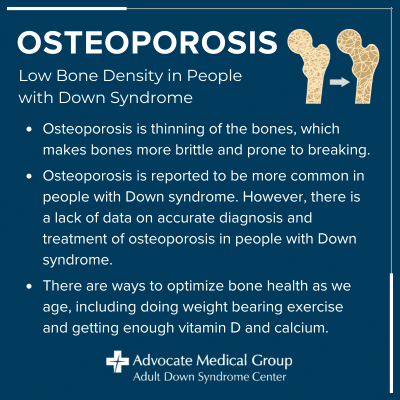
- Osteoporosis and osteopenia are thinning of the bones, which can make bones more prone to breaking.
- Osteoporosis is reported to be more common in people with Down syndrome, but there is a lack of data around accurate diagnosis and treatment of osteoporosis in this population.
- People with Down syndrome should discuss with their doctor if screening for osteoporosis may be appropriate.
What are osteoporosis and osteopenia?
Osteoporosis and osteopenia are conditions where bones become more brittle and prone to breaking. Osteopenia is the less severe form. It is a signal to work on improving bone health.
Anyone can develop these conditions, but women are more likely to. One-third of women will have a fracture due to this condition in their lifetime. During menopause, the decrease in estrogen makes women more prone to developing “less dense” bones.
Risk factors for osteoporosis
In people without Down syndrome, research has found that there are some risk factors for developing osteoporosis or osteopenia. Some of these risk factors are:
- lean body type (especially low weight)
- white or Asian descent
- inadequate calcium and vitamin D
- consuming too much protein and phosphate
- sedentary lifestyle
- smoking
- consuming more than 2 alcoholic drinks per day
- some stomach or intestinal problems such as celiac disease
- radiation therapy
- certain medications (for example, steroids for more than 3 months, seizure medications, chemotherapy)
There has not been enough research to assess these risks in people with Down syndrome.
Symptoms of osteoporosis
There are not many signs or symptoms of osteoporosis in people without Down syndrome. The same is probably true for people with Down syndrome. In a person with Down syndrome experiencing an osteoporotic fracture, one might notice them walking differently (which can also signal a different orthopedic cause as well). They may walk more slowly or with a limp. They may or may not be capable of communicating that they are experiencing pain.
Diagnosis of osteoporosis
To diagnosis osteoporosis, your doctor may order a DEXA scan (dual-energy x-ray absorptiometry). It is a painless whole-body x-ray which shows where weaknesses in the bones are located. It also shows by how much the bones are thinner than they should be. DEXA scans are recommended for women when they reach menopause, people diagnosed with celiac disease, and patients on high-risk medications.
DEXA scans are interpreted based on a number called a “T-score.” T-scores compare your value to a value of an average young healthy person.
- Normal: T-score greater than -1.0
- Osteopenia: T-score between -2.4 and -1.0
- Osteoporosis: T-score less than or equal to -2.5
If the DEXA scan is normal, we consider repeating the test in a few years to monitor.
Sometimes, doctors use the T-score result to calculate a FRAX score. FRAX scores estimate an individual’s risk of developing a fracture caused by osteoporosis in the next years.
There are limited studies evaluating DEXA scans in adults with Down syndrome (1). Additionally, there is a growing body of literature suggesting that DEXA scans inaccurately estimate bone density in people of shorter stature, which would include many adults with Down syndrome (2). This means that DEXA scans of shorter people report lower bone densities than they actually have.
Additionally, FRAX scores have not been tested in people with Down syndrome and may not be accurate for this population. This can result in diagnosing osteoporosis when bone health may be normal.
In the GLOBAL Medical Care Guidelines for Adults with Down Syndrome, because FRAX scores and DEXA scans have not been studied and/or shown to be effective tools in adults with Down syndrome, the guideline states (1):
“For primary prevention of osteoporotic fractures in adults with Down syndrome, there is insufficient evidence to recommend for or against applying established osteoporosis screening guidelines, including fracture risk estimates; thus, good clinical practice would support a shared decision-making approach to this issue.”
Shared decision-making is when a person and their doctor discuss that person’s health concerns and goals to decide which tests to run to meet an individual’s health needs.
Treatment of osteoporosis
The reason for diagnosing and treating osteoporosis is to reduce the risk of a fracture. However, there is little data evaluating the risk of osteoporotic fractures in adults with Down syndrome (2). This leaves the need to treat possible osteoporosis in adults with Down syndrome less clear.
To treat osteoporosis in people without Down syndrome, research has demonstrated the effectiveness of many medications. Three are described below.
Biophosphonates
Biophosphonates, such as alendronate (Fosamax) and risedronate (Actonel) have been shown to increase bone density and decrease fractures. These medications can be taken daily, weekly, or monthly based on specifics of the drug. Some side effects include inflammation/bleeding of the esophagus, gastric and duodenal ulcers, and, rarely, osteonecrosis (bone death) of the jaw.
Calcitonin
Calcitonin is a hormone that we naturally make. It can also be taken in nasal spray form. It has been shown to increase bone density but not to reduce fractures.
Raloxifene
Raloxifene (Evista) is a medication that affects estrogen receptors. It has been shown to increase bone density and decrease fractures of the spinal column bones but not the hip bones. It does have a risk of blood clots. One study found Down syndrome to be a risk factor for blood clots in children (3). People with Down syndrome may have other risk factors for blood clots, like autoimmune diseases. Therefore, there is some concern that adults with Down syndrome may be at increased risk of blood clots.
Medications to treat osteoporosis have not been studied in adults with Down syndrome. Bone remodeling is a normal part of bone health, where bone can break down and rebuild sections that need to be repaired. These are called bone remodeling pathways. Many medications to treat osteoporosis work by impacting different steps along these pathways.
There is some evidence that bone formation pathways work differently in people with Down syndrome (4, 5). If that is the case, then medications to treat osteoporosis (which work on these bone formation pathways) may work differently in people with Down syndrome. More study is needed on bone formation pathways in people with Down syndrome and on medications to treat osteoporosis in people with Down syndrome. For more information on some of the medications to treat osteoporosis, see Use of Prolia to Treat Osteoporosis.
In adults with Down syndrome who do experience an osteoporotic fracture, further testing is recommended (1).
Prevention of osteoporosis
Despite the fact that prevention of osteoporosis has not been specifically studied in adults with Down syndrome, it seems reasonable that many of the same prevention strategies for adults without Down syndrome may also help adults with Down syndrome (1). Though it is inevitable that we will lose some bone mass as we age, there are many daily interventions we can use to prevent osteopenia and osteoporosis. A few strategies are described below.
Weight bearing exercise
Weight bearing exercise such as walking, jogging, and dancing all increase bone density. Non-weight bearing exercises such as swimming and biking do not increase bone density but can increase body awareness which can help prevent falls that lead to fractures (6).
Vitamin D
Getting enough vitamin D in our diet is also essential in slowing and preventing osteoporosis and osteopenia. Our experience has found that many people with Down syndrome are deficient in vitamin D. It is not clear if this is related to having Down syndrome or to the fact that we live in a northern region where vitamin D deficiency is more common.
Adults require 600 international units (IU) of vitamin D every day. Vitamin D can come in the form of supplements or diet since most of us do not get adequate sunlight exposure which our bodies need to make vitamin D. Good non-supplemental nutritional sources are:
- Fish such as salmon, tuna, and mackerel
- Cheese and egg yolks. They have some vitamin D but not as much as fish.
- Foods fortified with vitamin D such as milk, many cheeses, yogurt, juices, and cereals.
Calcium
Calcium is also just as important. Adult men and pre-menopausal women require 1000mg a day. Post-menopausal women require 1500mg a day. Good sources of calcium are:
- Dairy (milk, cheese, yogurt)
- Leafy green vegetables
- Fruits (oranges, tangerines)
- Beans
- Peas
- Fish
Resources
Down syndrome
GLOBAL Medical Care Guidelines for Adults with Down Syndrome (Global Down Syndrome Foundation)
Use of Prolia to Treat Osteoporosis
References
1. Tsou AY, Bulova P, Capone G, et al. Medical care of adults with Down syndrome: A clinical guideline. JAMA. 2020;324(15):1543-1556. doi:10.1001/jama.2020.17024
2. Carfì A, Liperoti R, Fusco D, et al. Bone mineral density in adults with Down syndrome. Osteoporos Int. 2017;28(10):2929-2934. doi:10.1007/s00198-017-4133-x
3. Journeycake JM, Brumley LE. Down syndrome as an independent risk factor for thrombosis in children. Blood. 2006;108(11). doi:10.1182/blood.V108.11.1489.1489
4. LaCombe JM, Roper RJ. Skeletal dynamics of Down syndrome: A developing perspective. Bone. 2020;133:115215. doi:10.1016/j.bone.2019.115215
5. Thomas JR, Roper RJ. Current analysis of skeletal phenotypes in Down syndrome. Curr Osteoporos Rep. 2021;19(3):338-346. doi:10.1007/s11914-021-00674-y
6. Baughn M, Arellano V, Hawthorne-Crosby B, Lightner JS, Grimes A, King G. Physical activity, balance, and bicycling in older adults. PLoS One. 2022;17(12):e0273880. doi:10.1371/journal.pone.0273880
Join our mailing list
Sign up to receive emails with information on health topics for teens and adults with Down syndrome, updates on research and education as well as information about upcoming events, classes and programs.