
Menopause in Women with Down Syndrome
November 7, 2025
What is menopause?
Menopause is the point in a woman’s life when she no longer has menstrual cycles. It typically occurs when a woman is in her late 40s to 50s and is diagnosed after a woman has gone 12 months without a menstrual cycle. The term “perimenopause” describes the time leading up to the full 12-month cessation of periods. Sometimes periods can be irregular and sporadic for years before a woman goes a full twelve months with no menstrual cycle, meaning a woman can be perimenopausal for years.
Is menopause experienced differently by women with Down syndrome?
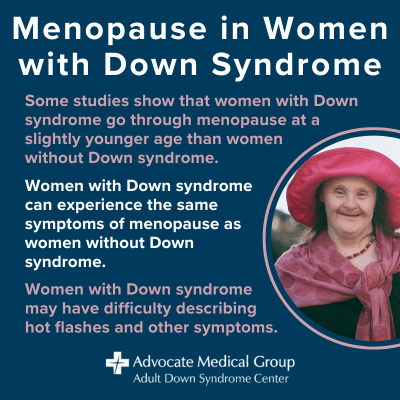
Women with Down syndrome tend to go through menopause at a slightly younger age. The median age of menopause in women with Down syndrome was reported to be 46 (Seltzer et al., 2001). The median age of menopause in white women without Down syndrome from industrialized countries was reported to be between the ages of 50-52. The median age at the onset of perimenopause in those same women was reported to be 47.5. There was some variation by race and ethnicity (Gold, 2011).
What are symptoms of menopause?
In women without Down syndrome, some common symptoms of menopause include:
- Changes in periods. Periods may become lighter, heavier, or have a more irregular timing. They may be longer or shorter than they were previously. A woman has not gone through menopause until it has been 12 months with no period, and she technically is still able to become pregnant up until she is officially through menopause.
- Hot flashes. Hot flashes cause a woman to suddenly feel heat and can be accompanied by red blotches on the skin. They can last 30 seconds to 10 minutes and can occur up to several times an hour. They can continue to occur for years after a woman goes through menopause.
- Trouble with sleep. During menopause, some women find that they have more trouble falling asleep or staying asleep.
- Vaginal dryness. Lack of estrogen can cause the vagina to be drier, which can make some women feel itchy and uncomfortable.
- Changes in mood. Some women develop depression or anxiety at the time of menopause.
- Loss of bladder control. Sometimes a woman will leak urine with exercise or when sneezing.
- And more.
What are symptoms of menopause in women with Down syndrome?
Women with Down syndrome can experience all of the same common symptoms of menopause as women without Down syndrome. It can be challenging for some women with Down syndrome to explain some of the symptoms they may be experiencing, and many of the women who have visited our clinic have not reported these symptoms. Hot flashes, in particular, seem to be a difficult concept for women with Down syndrome to describe. Sometimes caretakers may notice symptoms of menopause more than the woman with Down syndrome. Our Resource Library has a collection of visuals about menopause that may be helpful for women with Down syndrome.
Some women with Down syndrome report confusion and difficulty with memory as they experience menopause. It can be difficult to determine whether these symptoms are related to menopause or to the beginning of Alzheimer’s disease for postmenopausal women with Down syndrome. For more information, please see our article on the effect of menopause on cognition.
Although they are not always necessary, if there is a question of whether a woman has reached menopause, blood tests that assess hormone levels can be done. Your doctor can order these tests if they are deemed necessary.
How are menopausal symptoms treated?
The treatment of menopausal symptoms depends on which symptoms a woman is experiencing and how much they are affecting her life. Hormone replacement therapy (HRT) is one option for treating menopause symptoms. There have been many changes in recommendations regarding HRT over the last several decades. Additional information about HRT and what is known about HRT use in women with Down syndrome is available in this Hormone Replacement Therapy article.
Sometimes a vaginal hormone cream can be used to treat symptoms of vaginal dryness. The hormone in cream format allows for less absorption into the body and few side effects while still treating the vaginal dryness associated with menopause. There are also non-hormonal treatments for hot flashes and mood/sleep disorders. Prescription medications including paroxetine, venlafaxine, and gabapentin can all be effective at treating hot flashes. Studies also seem to suggest there can be some improvement in vaginal dryness and hot flashes with soy products (Hill et al, 2016).
Speaking with a doctor about menopause symptoms allows a woman and her doctor to develop a customized approach to treating the symptoms of menopause.
Resources
Down syndrome
Effect of Menopause on Cognition in Women with Down Syndrome
Hormone Replacement Therapy for Menopause Treatment in Women with Down Syndrome
Susan’s Experience with Menopause (Down’s Syndrome Association)
General
What Is Menopause? (National Institute on Aging)
References
Gold EB. The timing of the age at which natural menopause occurs. Obstet Gynecol Clin North Am. 2011;38(3):425-440. doi:10.1016/j.ogc.2011.05.002
Hill DA, Crider M, Hill SR. Hormone therapy and other treatments for symptoms of menopause. Am Fam Physician. 2016;94(11):884-889.
Seltzer GB, Schupf N, Wu HS. A prospective study of menopause in women with Down’s syndrome. J Intellect Disabil Res. 2001;45(Pt 1):1-7. doi:10.1046/j.1365-2788.2001.00286.x
Join our mailing list
Sign up to receive emails with information on health topics for teens and adults with Down syndrome, updates on research and education as well as information about upcoming events, classes and programs.