
Misunderstandings Caused by Different Perceptions
July 11, 2023
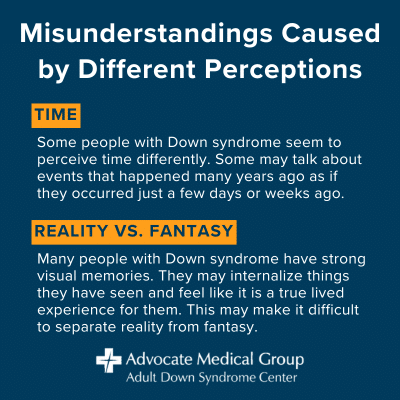
Sometimes, we are asked questions about individuals with Down syndrome who are said to be “lying” or “telling lies.” People with Down syndrome (just like people without Down syndrome) are capable of intentionally saying untrue things. However, we often find that there are other explanations for the “lying,” and the individual is not intentionally telling a lie, being dishonest deliberately, or having bad intent.
Therefore, I prefer not to use the word “lying” because it is usually viewed as a bad behavior that needs to be corrected, and this mindset can prevent us from recognizing the true cause of a behavior. Depending on the context, other phrases I may use are:
- “not truthful”
- “not based in facts”
- “something you wish would happen”
- “different than the way others saw the situation”
There are several explanations as to why these terms might be more appropriate.
Time
Time is an abstract concept that can be difficult for some individuals with Down syndrome. For example, if you ask a person when they went on vacation, they may say last week when they actually went on vacation several months ago. They may not be able to accurately estimate the amount of time that has passed and are probably not deliberately saying something that is untrue.
Communication skills
Some individuals with Down syndrome may lack the receptive and expressive language skills needed to communicate their thoughts accurately. They may mix up past, present, and future tenses. Additionally, they may have the needed skills but are not given enough time to process and formulate a response. They may default to certain phrases or responses that make it seem as though they are lying.
Reality vs. fantasy
Many individuals with Down syndrome have strong visual memories. They may internalize things they have seen and feel like it is a true lived experience for them. This may make it difficult to separate reality from fantasy. With a lot of individuals I see, I prompt them with questions like, “Is that what happened, or is that what you HOPE will happen?” That can help them think through what is fantasy and what is reality.
Empathy radar
We often hear that many individuals with Down syndrome are very perceptive of the feelings and emotions of the people around them (empathy radar) and they seek to please others. A person with Down syndrome may tell a “lie” because they think it is what the person wants to hear.
Critical thinking
Lying may also be a behavior used by a person with Down syndrome to get their needs met or to avoid punishment. They may lack the planning or critical thinking skills to evaluate alternate courses of action beyond lying. It is very important to understand why a person is not being truthful and teach them how to get their needs met without lying.
These explanations can encourage us to take a different perspective that is more helpful in understanding a behavior.
Mental Wellness in Adults with Down Syndrome provides additional information about these topics including empathy radar (chapter 4), time perception (chapter 5), and communication (chapter 7).
Join our mailing list
Sign up to receive emails with information on health topics for teens and adults with Down syndrome, updates on research and education as well as information about upcoming events, classes and programs.