
Ulcers in the Esophagus, Stomach, and Small Intestine in People with Down Syndrome
June 11, 2025
Key Points
- Ulcers are open sores in the gastrointestinal tract.
- They are commonly caused by Helicobacter pylori infection but anti-inflammatory medications (e.g., ibuprofen) may also contribute.
- Ulcers in the esophagus, stomach, and the duodenum (the first part of the small intestine) are more common in people with Down syndrome.
- There are several tests that may be ordered to diagnose ulcers, assess for risk factors, and/or evaluate for complications.
- Treatment usually involves dietary changes, avoiding some medications and/or taking other medications.
What are ulcers?
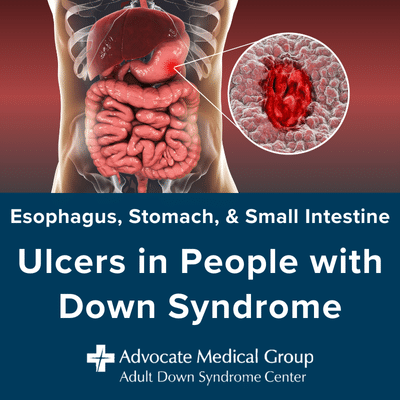
Ulcers are open sores in the gastrointestinal (GI) tract. Esophageal ulcers are ulcers in the esophagus (the tube that carries from the mouth to the stomach). Peptic ulcers refer to ulcers in the stomach or the duodenum (the first part of the small intestine).
Symptoms
Peptic ulcers commonly cause pain in the upper part of the abdomen (roughly the area between the ribs and the belly button; also called the epigastrium). The pain is often described as burning or gnawing. It often worsens when the stomach is empty or after eating.
Esophageal ulcers may cause difficulty with swallowing or painful swallowing, heartburn, or a feeling of something stuck in the throat.
Peptic and esophageal ulcers may also cause:
- Indigestion
- Bloating
- Nausea
- A sensation of feeling full
- Weight loss
- Loss of appetite
- Back pain
- Vomiting
Ulcers can cause bleeding in the GI tract. Anemia can also occur. It can happen gradually if the bleeding is slow. However, anemia can occur suddenly and severely, becoming a medical emergency.
Uncommonly, the ulcer can erode through the wall of the esophagus, stomach, or duodenum. It can cause a perforation or hole in the wall. This complication requires emergent evaluation and treatment.
What causes ulcers?
In the past, certain foods (such as spicy foods) and stress were blamed for ulcers. However, it is now known that the two most common causes of ulcers are a bacterial infection called Helicobacter pylori (or H. pylori) and/or the use of anti-inflammatory medications. Spicy foods and stress may worsen the symptoms or the effects of H. pylori infection or anti-inflammatory medications.
The H. pylori bacteria is spread by person-to-person contact, by touching objects or surfaces that someone with H. pylori has touched, or from contaminate food or liquid. Regular hand hygiene is important to reduce the spread to other people.
Taking anti-inflammatory medications (orally) such as ibuprofen (Advil, Motrin) or naproxen (Naprosyn) can also contribute to ulcers. The longer the use of the medications, the higher the risk. However, some individuals may develop ulcers within 1-2 weeks of using the medications.
Bisphosphonates are another medication that can cause esophageal and peptic ulcers. These medications are used to treat osteoporosis. To avoid side effects, doctors typically direct patients to:
- Take the medication on an empty stomach with water
- Stay upright (not lying down) for at least 30 minutes after taking the medication
Why are ulcers important in Down syndrome?
In our study of people with Down syndrome seen in our health system, stomach and duodenal ulcers were nearly 1.5 times more common in people with Down syndrome compared to people without Down syndrome. Esophageal disorders were also about 1.5 times more common, but this included all esophageal disorders, not only esophageal ulcers.
Why are ulcers more common in people with Down syndrome?
People with Down syndrome may have more ulcers because they are at increased risk of infections, including the Helicobacter pylori infection that causes ulcers.
Gastroesophageal reflux disease (GERD, heartburn) is more common in people with Down syndrome. GERD occurs when acid in the stomach goes backwards out of the stomach into the esophagus. GERD can contribute to more ulcers.
In our experience, people with Down syndrome may develop ulcers more frequently when taking bisphosphonates used for osteoporosis. It is not clear if this is caused by:
- Increased sensitivity to the medication
- Increased likelihood of having GERD
- Difficulty complying with the directions for taking the medication (taking it on an empty stomach and staying upright for at least 30 minutes)
Symptoms in people with Down syndrome
Pain is often the first symptom reported when someone has an ulcer. However, some people with Down syndrome do not report that they are in pain, or it takes them longer than expected to report that they are in pain. If a person with Down syndrome does not complain of pain, the first symptom of an ulcer may be a fainting episode or dizziness due to severe anemia.
Diagnosis
The assessment starts with a good history and physical exam. The health professional will ask about symptoms, risk factors, and complications related to ulcers (including bleeding). The health professional will do a physical exam to check for abdominal (and possibly back) tenderness and signs of bleeding.
If the health professional suspects an ulcer, additional tests may be ordered.
Blood tests
- Complete blood count (CBC) to assess for anemia.
- Gastrin level. Gastrin is a hormone that causes acid to be produced in the stomach. If the gastrin level is high, it can cause an increase in acid in the stomach, which can cause ulcers.
Breath test
Helicobacter pylori breath test (also called urea breath test). The person drinks a liquid with urea in it. If there is Helicobacter pylori bacteria, it will break down the urea and release carbon dioxide. The breath test measures carbon dioxide. A high level of carbon dioxide indicates that a person has Helicobacter pylori infection.
Stool test
Stool antigen test for Helicobacter pylori infection. A stool sample is collected. A lab can measure for proteins related to the bacteria.
Endoscopy
- An endoscopy (esophagogastroduodenoscopy or EGD) is a scope that is passed through the mouth. It allows the physician doing the test to see the esophagus, stomach, and duodenum.
- A biopsy of the ulcer can be done during the endoscopy to assess for H. pylori.
Imaging
- A computerized tomography (CT) scan is sometimes ordered to check for complications from an ulcer or other possible causes of the symptoms.
- An esophagram and/or an upper GI barium study use barium during x-ray testing to look at the esophagus and stomach/duodenum. These are not done as frequently as in the past because of the availability of EGDs.
Treatment
Treatment most often includes one or more of the following:
Reducing acid
Acid can be reduced by:
- Avoiding foods that may contribute to symptoms (for example, acidic foods such as orange juice)
- Avoiding anti-inflammatory medications such as ibuprofen and naproxen
Acid can also be reduced by taking medications.
- H2 blockers such as rantidine (Zantac) or famotidine (Pepcid). These medications reduce acid production in the stomach. Long-term use may contribute to decreased absorption of some vitamins and minerals, increased hip fractures, and some other side effects.
- Proton pump inhibitors (PPIs) such as omeprazole (Prilosec), lansoprazole (Prevacid), pantopricezole (Protonix), rabeprazole (Aciphex), and esomeprozole (Nexium). These medications also reduce acid production in the stomach. Some research suggests long-term use of PPIs may contribute to the development of Alzheimer’s disease, reduce magnesium in the body, increase the risk of fractures, and some other complications.
- Antacids such as calcium carbonate (Tums) and aluminum hydroxide, magnesium hydroxide, and simethicone (Maalox) can be used as needed to reduce symptoms. They neutralize (reduce the acidity) of the liquid in the stomach. Long-term use may also increase the risk of fractures, nutrient deficiencies, and some other side effects. However, with the availability of H2 blockers and PPIs, antacids are often not used as the primary treatment any longer.
Treating Helicobacter pylori infection
If H. pylori is diagnosed or suspected, antibiotics are prescribed to kill the bacteria. A combination of antibiotics and other medications are usually taken for two weeks. Probiotics may help reduce ulcers by replenishing “good” bacteria which may reduce H. pylori. More research is needed as to which probiotics are beneficial and the doses needed.
Treating bleeding
If an EGD shows that an ulcer is actively bleeding, sometimes the bleeding can be stopped by cauterizing (burning) the site. During an EGD, medications or substances can also sometimes be injected into the bleeding site to control the bleeding.
Treating anemia
If anemia is diagnosed, supplements may be recommended. Iron deficiency anemia is a common complication of bleeding ulcers. Iron supplements may be needed.
Surgery
Occasionally, surgery may be recommended if an ulcer does not respond to medications. Surgery usually involves removing the ulcer and cutting the nerve that stimulates the stomach to make acid.
Resources
Down syndrome
Gastroesophageal Reflux Disease
General
Stomach Ulcer (Cleveland Clinic)
Peptic Ulcer (Mayo Clinic)
Helicobacter Pylori Infection (Mayo Clinic)
References
Chicoine B, Rivelli A, Fitzpatrick V, Chicoine L, Jia G, Rzhetsky A. Prevalence of common disease conditions in a large cohort of individuals with Down syndrome in the United States. J Patient Cent Res Rev. 2021;8(2):86-97. doi:10.17294/2330-0698.1824
Join our mailing list
Sign up to receive emails with information on health topics for teens and adults with Down syndrome, updates on research and education as well as information about upcoming events, classes and programs.