Heart Disease in Adults with Down Syndrome
June 24, 2026

Key points
- Heart disease is a broad term that includes many conditions that affect how the heart works.
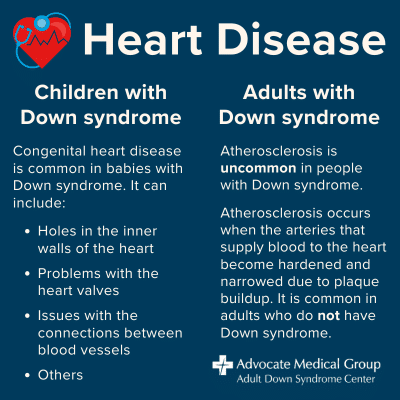
- Children with Down syndrome often are born with heart problems (called congenital heart disease). These can include holes in the inner heart walls, abnormal heart valves, blood vessels that connect incorrectly, and others.
- Adults with Down syndrome uncommonly develop “hardening of the arteries” (atherosclerosis), which is a common cause of heart disease in adults without Down syndrome.
- High blood pressure (hypertension) is also uncommon in adults with Down syndrome, so heart problems caused by high blood pressure are rare.
- Adults with Down syndrome can develop other types of heart disease. They can include long-term complications of congenital heart disease as well as problems unrelated to congenital heart disease.
- Adults with Down syndrome who had congenital heart disease should see a cardiologist regularly (if possible, one who specializes in adult congenital heart conditions).
Heart disease
Heart disease refers to many different problems that affect the heart or blood vessels. Some problems occur from the time someone is born (congenital). Other problems develop over time.
The term cardiovascular disease is also used. It refers to diseases of the heart and the blood vessels.
Symptoms and complications of heart disease
Heart disease can cause a wide range of symptoms. Some of the more common ones include:
- Chest pain
- Pain in the neck or arms
- Shortness of breath or difficulty breathing
- Fatigue
- Dizziness or shortness of breath
- Feeling your heartbeat is too fast or too slow
- Blue discoloration of the skin (cyanosis)
- Swelling in the legs, feet, or other body parts
- Excessive sweating
- Stroke
- Sudden death
Types of heart disease
Congenital heart disease
Congenital heart disease means a person is born with a heart abnormality. Examples include:
- Holes inside the heart
- Abnormal blood vessel connections
- Valve problems
- And others
About 40-50% of infants with Down syndrome are born with congenital heart disease. Many do very well after treatment, but they will need lifelong monitoring (see Screening section below). There is still much to learn about the potential long-term complications of treated (or untreated) congenital heart disease.
Atherosclerosis (“hardening of the arteries”)
Arteries are blood vessels that carry blood away from the heart towards the rest of the body, including blood vessels that carry blood to the muscles in the heart. Atherosclerosis happens when fats, cholesterol, and other substances build up in artery walls. This can block blood flow and cause:
- Chest pain (angina)
- Heart attacks (myocardial infarctions)
Atherosclerosis and heart attacks caused by atherosclerosis are very common in adults without Down syndrome; however, they are uncommon in adults with Down syndrome.
Risk factors
It is not clear why atherosclerosis occurs so infrequently in people with Down syndrome. Some of the risk factors for atherosclerosis are more common while others are less common in people with Down syndrome. For example, obesity and inactivity are more common in people with Down syndrome. However, high blood pressure (hypertension) and smoking are less common in people with Down syndrome.
Chest pain in people with Down syndrome
Chest pain is a common symptom of heart disease. However, it is not usually caused by atherosclerotic heart disease in people with Down syndrome. Some of the more likely causes of chest pain in a person with Down syndrome include:
- Heartburn from gastroesophageal reflux
- Chest pain associated with gallstones
- Problems with the esophagus (the tube between the mouth and the stomach sometimes does not propel food in its normal fashion in people with Down syndrome, which can cause pain)
- Other types of heart disease (such as demand ischemia described below)
Heart failure (or congestive heart failure)
Heart failure means the heart cannot pump enough blood for the body’s needs. It can be caused by:
- Having high blood pressure (hypertension) for a long time
- Heart attacks (myocardial infarctions)
- Diseases of one or more of the valves in the heart
- Congenital heart problems
- Conditions that make the heart work too hard (such as severe sleep apnea or anemia)
- Abnormalities of the heart muscle (cardiomyopathy)
- And others
It is not clear from research how frequent heart failure occurs in people with Down syndrome. However, they may have a higher chance of heart failure because conditions like congenital heart disease, abnormal heart valves, sleep apnea, abnormal heart rhythms, and certain lung diseases are more common in people with Down syndrome. On the other hand, other causes of heart failure are less common such as high blood pressure (hypertension) and heart attacks (myocardial infarctions) caused by atherosclerosis.
Abnormal heart rhythms
An irregular heartbeat (arrhythmia) is a potential complication of congenital heart disease. It can occur in both children and adults with Down syndrome. Arrhythmias can cause:
Abnormal heart rhythms are more common in people with Down syndrome. Having a history of congenital heart disease contributes but it is also true for people with Down syndrome who did not have congenital heart disease. Differences in the autonomic nervous system probably also contribute to more abnormal heart rhythms in people with Down syndrome.
Valvular heart disease
Heart valve problems may prevent blood from flowing appropriately through and out of the heart. Valvular heart disease is more common in children with Down syndrome because of congenital heart disease. It is also more common in adults with Down syndrome, partly because of differences in collagen and connective tissue in people with Down syndrome.
Infections of the heart (endocarditis)
Infections caused by bacteria and other infectious organisms can occur in the heart. These infections can cause:
- Valvular heart disease
- Heart failure
- Strokes
- Abnormal heart rhythms
- Sepsis (severe infections)
- Other complications
Research is not clear about the frequency of endocarditis in people with Down syndrome. However, congenital heart disease and other structural abnormalities make people more at risk for endocarditis. This suggests that people with Down syndrome could be at more risk due to their increased frequency of congenital heart disease.
Ischemia not caused by atherosclerosis (sometimes called demand ischemia)
Inadequate blood flood to the heart muscle can occur even if the arteries are “normal” (do not have atherosclerosis or narrowing of the arteries). Demand ischemia occurs when increased oxygen demand or reduced oxygen supply cause injury to the heart. The demand of the heart for oxygen is greater than the heart’s ability to pump blood, but it is not caused by atherosclerosis.
This type of ischemia is more common in people with Down syndrome. It can be caused by congenital heart disease, rhythm abnormalities, valvular heart disease, and other heart problems. Sleep apnea and anemia can also contribute to demand ischemia.
Demand ischemia can cause heart attacks (myocardial infarctions).
Hypertensive heart disease
This is heart disease caused by long-term high blood pressure (hypertension). Since high blood pressure is uncommon in people with Down syndrome, this type of heart disease is also uncommon.
Pericardial disease
The sac around the heart (pericardium) can become inflamed (pericarditis) or fill with fluid (pericardial effusion). There are many possible causes including infection, underactive thyroid (hypothyroidism), radiation, trauma, heart failure, and others. If too much fluid builds up, it can prevent the heart from pumping appropriately and can become life-threatening.
Hypothyroidism is a common cause or contributing factor of pericardial disease in people with Down syndrome. Regular screening and treatment for hypothyroidism is important.
In our clinical experience, we have seen many individuals with Down syndrome with small pericardial effusions but very few that were causing (or later caused) heart dysfunction. We have found these small pericardial effusions even when the thyroid function is normal.
Infants with Down syndrome commonly develop a condition called transient abnormal myelopoiesis (TAM) which can cause pericardial effusion.
Screening recommendations
According to the Global Medical Care Guidelines for Adults with Down Syndrome:
- For atherosclerotic disease*: “For adults with Down syndrome without a history of atherosclerotic cardiovascular disease (ASCVD), the appropriateness of statin therapy should be assessed every 5 years starting at age 40 and using a 10-year risk calculator as recommended for adults without Down syndrome by the U.S. Preventive Services Task Force.”
- For congenital heart disease: “In adults with Down syndrome with a history of congenital heart disease, given the elevated risk of cardioembolic stroke, a periodic cardiac evaluation and a corresponding monitoring plan should be reviewed by a cardiologist.”
*Statins can cause mitochondrial dysfunction, which is already more common in people with Down syndrome. More information is available in this Mitochondria in Down Syndrome article.
Resources
Down syndrome
Cholesterol (podcast episode from the Down Syndrome Center of Western Pennsylvania)
Dysphagia (Swallowing Problems)
Gastroesophageal Reflux Disease
GLOBAL Medical Care Guidelines for Adults with Down Syndrome
Hypertension and Hypotension (High and Low Blood Pressure)
Hypothyroidism and Hyperthyroidism (Underactive and Overactive Thyroid)
General
Heart Anatomy & Function (Cleveland Clinic)
Heart Disease (Cleveland Clinic)
Pericardial Effusion (Cleveland Clinic)
References
Chicoine B, Rivelli A, Fitzpatrick V, Chicoine L, Jia G, Rzhetsky A. Prevalence of common disease conditions in a large cohort of individuals with Down syndrome in the United States. J Patient Cent Res Rev. 2021;8(2):86-97. doi:10.17294/2330-0698.1824
Cho JH, Choi EK, Moon IK, et al. Chromosomal abnormalities and atrial fibrillation and ischemic stroke incidence: a nationwide population-based study. Sci Rep. 2020;10(1):15872. doi:10.1038/s41598-020-72678-0
Dimopoulos K, Constantine A, Clift P, et al. Cardiovascular complications of Down syndrome: Scoping review and expert consensus. Circulation. 2023;147(5):425-441. doi:10.1161/CIRCULATIONAHA.122.059706
Dodd KJ, Shields N. A systematic review of the outcomes of cardiovascular exercise programs for people with Down syndrome. Arch Phys Med Rehabil. 2005;86(10):2051-2058. doi:10.1016/j.apmr.2005.06.003
Fitzpatrick V, Rivelli A, Bria K, Chicoine B. Heart disease in adults with Down syndrome between 1996 and 2016. J Am Board Fam Med. 2020;33(6):923-931. doi:10.3122/jabfm.2020.06.190425
Gurvitz M, Krieger EV, Fuller S, et al. 2025 ACC/AHA/HRS/ISACHD/SCAI Guideline for the management of adults with congenital heart disease: A report of the American College of Cardiology/American Heart Association Joint Committee on Clinical Practice Guidelines. J Am Coll Cardiol. Published online December 18, 2025. doi:10.1016/j.jacc.2025.09.006
Ntiloudi D, Rammos S, Karakosta M, Kalesi A, Kasinos N, Giannakoulas G. Arrhythmias in patients with congenital heart disease: An ongoing morbidity. J Clin Med. 2023;12(22):7020. doi:10.3390/jcm12227020
Pedersen A, Nordenvall AS, Tettamanti G, Nordgren A. Age-related cardiovascular disease in Down syndrome: A population-based matched cohort study. J Intern Med. 2025;297(6):683-692. doi:10.1111/joim.20093
Tsou AY, Bulova P, Capone G, et al. Medical care of adults with Down syndrome: A clinical guideline. JAMA. 2020;324(15):1543-1556. doi:10.1001/jama.2020.17024
Join our mailing list
Sign up to receive emails with information on health topics for teens and adults with Down syndrome, updates on research and education as well as information about upcoming events, classes and programs.