
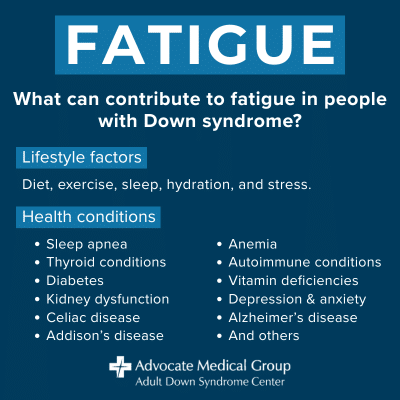
Key Points
- Fatigue is a common symptom for people with and without Down syndrome. It involves feelings of extreme tiredness and lack of energy.
- Lifestyle choices can contribute to fatigue. There are a variety of lifestyle changes that can improve health and may reduce fatigue in people with and without Down syndrome.
- Some health conditions can also contribute to fatigue. Several of these conditions that can cause fatigue are more common in people with Down syndrome. An evaluation by a health care professional is important.
Lifestyle
The following sections contain a lot of information about potential changes that can be made to reduce fatigue. Consider starting with one or two changes and adding more changes with time. In her article Tips for Building a New Habit or Routine, Katie Frank, PhD, OTR/L, provides additional strategies that may help.
Diet
A healthy diet can improve health and reduce fatigue. We recommend considering:
- Think moderation! Trying to restrict too much can lead to cravings.
- Limit or eliminate added sugar and artificial sweeteners from the diet. Added sugar includes putting sugar into or onto foods and drinks either at the time it is consumed or when it is prepared at home, in restaurants, or by the food processor.
- Opt for unprocessed or minimally processed foods and limit or eliminate highly processed foods such as white bread, packaged snacks, candy, soda, etc.
- Some examples of healthy diets are the Mediterranean diet, plant-based diet, and DASH diet.
Exercise
Exercise is an important part of health promotion, and exercising regularly can reduce fatigue. The Physical Activity Guidelines for Americans recommend the following for adults:
- Do at least 150 to 300 minutes of moderate-intensity exercise per week or 75 to 150 minutes of vigorous-intensity exercise per week.
- Do muscle-strengthening activities of moderate or greater intensity that involve all major muscle groups on 2 or more days per week.
Information on what constitutes moderate-intensity and vigorous-intensity exercise in people with Down syndrome is available in this Heart Rates and Exercise article.
Sleep
There are several behaviors or actions that can be used to improve sleep – this is called sleep hygiene. It includes habits such as going to bed at the same time each night, turning off electronic devices an hour before bedtime, limiting caffeine (especially in the evening), not keeping phones and electronic devices near the bed, and having a bedtime routine.
Hydration
Drinking plenty of fluids improves overall health and can reduce fatigue. Some recommendations include:
- Drinking 6-8 cups of water per day
- Using a tracker to improve compliance with the water consumption goal
- Increasing fluid intake when active and on warmer days
Additional ideas and visuals are shared in this Tips for Staying Hydrated article.
Stress
Stress can lead to sleep disruption, persistent muscle tightness, emotional distress, and other symptoms that can cause fatigue. Learning techniques for managing stress is important for navigating a variety of life stressors. When used effectively, stress management techniques may also reduce fatigue. Tips and resources are provided in this How to Cope with Stress article.
Our Recipe for Health webinar includes more information on health promotion.
Health conditions
Many health conditions can cause fatigue in people with and without Down syndrome. A health care professional can make an assessment to identify possible causes and develop a treatment plan. A partial list of possible causes includes:
Sleep apnea and other causes of sleep impairment
Sleep apnea is more common in people with Down syndrome. The type of sleep apnea that is most common in people with Down syndrome is obstructive sleep apnea.
Other causes for sleep disturbance are also more common in people with Down syndrome. Examples include gastroesophageal reflux disease (GERD, heartburn), conditions that cause pain, and Down syndrome regression disorder.
Hypothyroidism and hyperthyroidism
An underactive thyroid gland (hypothyroidism) and an overactive thyroid gland (hyperthyroidism) can both cause fatigue. About 40% of people with Down syndrome have hypothyroidism. While hyperthyroidism is also more common in people with Down syndrome, it is not as common as hypothyroidism.
Additional information is available in this Hypothyroidism and Hyperthyroidism article.
Diabetes mellitus
Type 1 diabetes mellitus is more common in people with Down syndrome. The onset is usually in childhood and requires insulin. Studies have found mixed results on the frequency of type 2 diabetes mellitus. In a study of people with Down syndrome seen in our health system, type 2 diabetes was less common in people with Down syndrome compared to people without Down syndrome. In a study from the UK, type 2 diabetes was more common in people with Down syndrome during childhood and young adulthood. It was as common or less common in older age groups.
Type 2 diabetes is often managed with diet, exercise, and oral medications (pills) but does sometimes require insulin.
Kidney dysfunction
A worsening in kidney function can be caused by a variety of conditions including dehydration, impaired bladder function, urinary tract infections, and others.
Addison’s disease
The adrenal gland produces hormones that have many functions. Addison’s disease occurs when the adrenal gland produces insufficient amounts of hormones. It can cause fatigue. Addison’s disease is more common in people with Down syndrome compared to people without Down syndrome.
Celiac disease
Celiac disease is caused by an autoimmune response to gluten. It causes inflammation in the small intestine. It can cause many symptoms, both in the gastrointestinal system (e.g., diarrhea) and not in the gastrointestinal system (e.g., depression, fatigue). Celiac disease is more common in people with Down syndrome.
Vitamin deficiencies
A variety of vitamin deficiencies may contribute to fatigue. More information is available in this Vitamins and Supplements article and this Vitamin B12 and Folate article.
Anemia
A low red blood cell count (anemia) can cause fatigue. This Iron Deficiency article and this MCH and MCV: Differences in Red Blood Cells of People with Down Syndrome article discuss some of the causes of anemia.
Cancer
Cancer can cause fatigue. Fortunately, most cancer is less common in adults with Down syndrome.
Heart disease
Impaired heart function can cause fatigue. Heart attacks (myocardial infarctions) due to atherosclerosis (narrowing of the arteries due to buildup of fats, cholesterol, calcium, and white blood cells) are less common in people with Down syndrome. However, untreated congenital heart disease, valvular heart disease, slow or fast heart rate, or long-term complications of previously repaired congenital heart disease can all cause fatigue.
Autoimmune conditions
There are many autoimmune conditions that are more common in people with Down syndrome. In an autoimmune condition, the immune system attacks some part(s) of the body. Several of the conditions listed above may be caused by autoimmunity. These include type 1 diabetes mellitus, hypothyroidism, hyperthyroidism, some vitamin deficiencies, celiac disease, and Addison’s disease. Inflammatory arthritis (e.g., Down syndrome-associated arthritis) is also caused by autoimmunity.
Depression and anxiety
Fatigue can be one of the symptoms of depression and anxiety. Both conditions are more common in people with Down syndrome. The health promotion efforts described above can help reduce, eliminate, and/or prevent these symptoms. Additional treatment, including counseling, medication, and treating contributing physical causes, may also be needed.
Neurological conditions
Seizures
Seizures are more common in people with Down syndrome. There are two peaks of onset – childhood and older adulthood. Seizures may present with sudden loss of consciousness. They may or may not have the typical shaking movements. There is typically a period after a seizure (called post-ictal) during which the person may be very sleepy. Recurrent seizures can cause a person to be fatigued.
Brain injuries, strokes, and tumors
Brain injuries or conditions such as strokes or tumors can cause sleepiness. Fortunately, brain tumors are less common in people with Down syndrome. Strokes due to narrowing of the arteries are also less common in people with Down syndrome. However, strokes due to clots coming from inside the heart are more common in people with Down syndrome.
Alzheimer’s disease
Alzheimer’s disease may cause apathy and less interest in activities. It can also cause a tendency to fall asleep more easily. Fatigue is usually a later symptom. Other symptoms such as memory impairment, mood changes, decline in function, etc. are typically noted first. Additional information is available in the Alzheimer’s disease section of our Resource Library.
Additional considerations
It is often noted that a person with or without Down syndrome can stay awake for active activities but not passive ones. This may be true for a variety of causes of fatigue. The individual’s ability to resist sleep may be adequate if there is something that keeps the individual active and moving. For example, many adults with Down syndrome and their families have described falling asleep easily in the car but being able to stay awake for activities.
Assessment by a health care professional starts with a good history and physical exam looking for symptoms and signs of the conditions listed above. There are other conditions that can cause fatigue that may need to be considered. The findings of the health care professional’s evaluation will guide next steps that may include lab testing and imaging (x-ray, CT scan, MRI).
Resources
General
DASH Eating Plan (National Heart, Lung, and Blood Institute)
How to Start a Plant-Based Diet (Mayo Clinic)
Mediterranean Diet (Cleveland Clinic)
Physical Activity Guidelines for Americans (Office of Disease Prevention and Health Promotion)
Down syndrome
Celiac Disease (article)
Depression (article)
Down Syndrome Regression Disorder (National Down Syndrome Society)
Exercise and Physical Activity (resource list)
Gastroesophageal Reflux Disease (article)
Generalized Anxiety Disorder (article)
Heart Rates and Exercise (article)
How to Cope with Stress (article)
Hypothyroidism and Hyperthyroidism (article)
Iron Deficiency (article)
Kidney Function (article)
MCH and MCV: Differences in Red Blood Cells of People with Down Syndrome (article)
Pain (article)
Recipe for Health (webinar)
Seizures (article)
Seizures in People with Down Syndrome and Alzheimer’s Disease (article)
Sleep (resource list)
Sleep Apnea (article)
Strokes (article)
Tips for Building a New Habit or Routine (article)
Tips for Staying Hydrated (article)
Vitamins and Supplements (article)
Vitamin B12 and Folate (article)
References
Aslam AA, Baksh RA, Pape SE, et al. Diabetes and obesity in Down syndrome across the lifespan: A retrospective cohort study using U.K. electronic health records. Diabetes Care. doi:10.2337/dc22-0482
Rivelli A, Fitzpatrick V, Wales D, et al. Prevalence of endocrine disorders among 6078 individuals with Down syndrome in the United States. J Patient Cent Res Rev. 2022;9(1):70-74. doi:10.17294/2330-0698.1877
Join our mailing list
Sign up to receive emails with information on health topics for teens and adults with Down syndrome, updates on research and education as well as information about upcoming events, classes and programs.