
Cholesteatomas in People with Down Syndrome
June 28, 2023
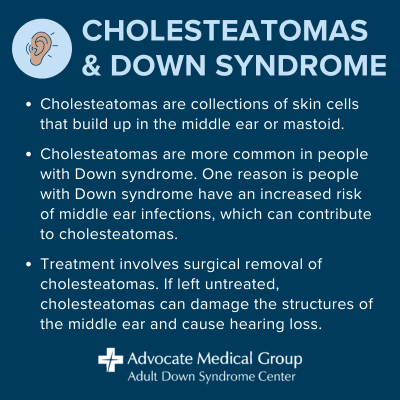
What are cholesteatomas?
A cholesteatoma is a collection of skin cells that become more fibrous and build up in the middle ear (where the small bones are that are part of our hearing mechanism) or mastoid (an air-filled area within the bone behind the ear). A cholesteatoma may be congenital (born with it) or acquired. Acquired cholesteatomas often occur when there is a hole in a person’s ear drum (perforated tympanic membrane) or when a person’s ear drum is pulled toward the middle ear (retracted tympanic membrane). If left untreated, cholesteatomas can damage the structures of the middle ear (and cause hearing loss).
Are cholesteatomas common in people with Down syndrome?
Middle ear infections (otitis media) are more common in children with Down syndrome. The infections and the higher likelihood of perforations or ear tubes due to middle ear infections can contribute to developing a cholesteatoma. One study on prevalence of cholesteatomas found them to be 7 times more likely in children with Down syndrome compared to children without Down syndrome.
The diagnosis should be considered in a person with Down syndrome who has had multiple ear infection, particularly if they have had multiple sets of ear tubes. Regular follow up with an otolaryngologist (ENT physician) is often recommended. If there is a suspicion of a cholesteatoma on the exam, a CT scan can be done to confirm the diagnosis.
How are cholesteatomas treated?
Treatment involves surgical removal of the cholesteatoma (typically done by an otolaryngologist). Additional information on the surgery in people with Down syndrome is available in these articles:
Challenges and Outcomes of Cholesteatoma Management in Children with Down Syndrome
Prevalence and Surgical Management of Cholesteatoma in Down Syndrome Children
Surgical Treatment of Middle Ear Cholesteatoma in Children with Down Syndrome
For more resources, please see the Otolaryngology (ENT) section of our Resource Library.
Join our mailing list
Sign up to receive emails with information on health topics for teens and adults with Down syndrome, updates on research and education as well as information about upcoming events, classes and programs.