
Self-Injurious Behavior
March 6, 2020
What is self-injurious behavior?
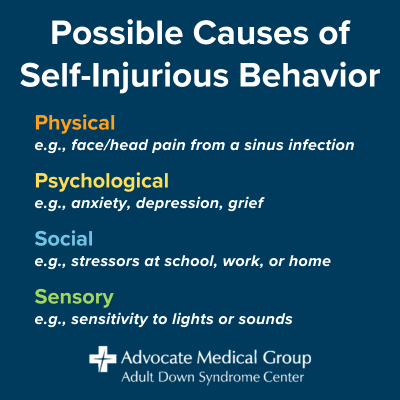
Self-injurious behavior (SIB) is behavior that an individual does that results in harm to their own body. These behaviors may include hitting oneself, striking a body part against an object, throwing oneself on the floor, and/or head banging. Individuals with SIB are rarely trying to end their life through suicide.
Causes
There are many possible causes of SIB, and it can be challenging to treat.
Some examples of physical causes are:
- A person might hit their head when they have face or head pain from a sinus infection.
- A person might become agitated due to hyperthyroidism (overactive thyroid).
- A person might stomp or kick their feet in response to numbness or discomfort caused by peripheral neuropathy, a condition that occurs when nerves outside the brain and spinal cord are damaged. Diabetes can cause peripheral neuropathy.
- A person might scratch their face or arms in response to a seizure.
Some examples of psychological causes are:
- Anxiety
- Depression
- Grief
- Psychosis, a severe mental disorder that causes people to lose contact with reality
Some examples of social causes are:
- Stressors at school, work, or home
- Inappropriate interactions with others
- The desire for attention that is successfully obtained through SIB
Some examples of sensory causes are:
- A person might strike or poke their eyes if they are sensitive to certain lights.
- A person might hit their head against a wall in response to sensitivity to loud sounds.
Assessment and Treatment
- Assessing for and treating underlying physical and mental health problems
- Assessing for contributing sensory issues
- Specifically, address hypersensitive sensory issues.
- Use general sensory input techniques to aid in relaxation.
- Counseling when appropriate
- Utilizing relaxation techniques per the individual’s preferences (e.g., soft music, darkened rooms)
- Using visual reminders
- For example:
- A visual could be used that shows a picture of the undesired SIB with a red “X” through it and pictures of appropriate relaxation techniques.
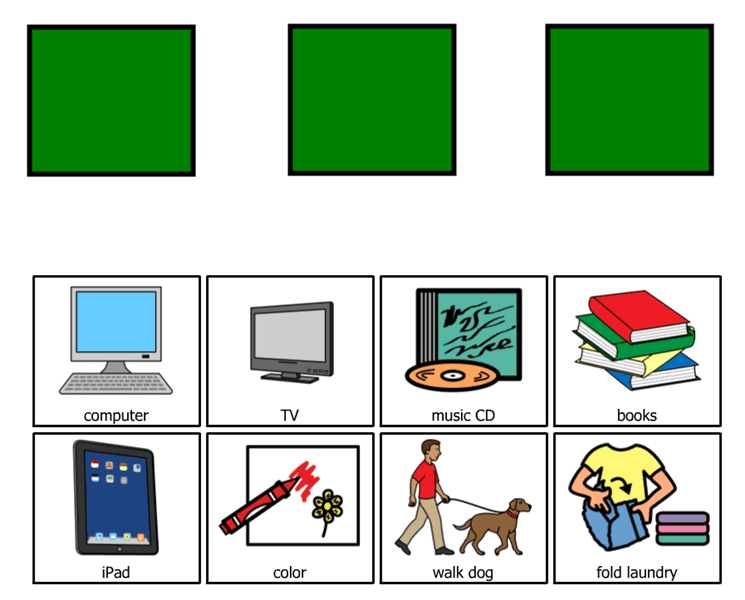
- A self-modeling video could be made that shows the individual using the more appropriate relaxation techniques.
- A visual could be used that shows a picture of the undesired SIB with a red “X” through it and pictures of appropriate relaxation techniques.
- It can be helpful for individuals to look at the visuals or watch the videos at the beginning of each day to remind them to use appropriate relaxation techniques throughout the day.
- For example:
- Behavioral management
- This may include a reward system for appropriate behavior. Enlisting the assistance of a professionally trained behaviorist can be helpful. A behaviorist can assess for contributing environmental factors, suggest rewards to use, and identify techniques to avoid inadvertently rewarding inappropriate behaviors.
When additional treatment is needed, there are several small studies (see below) that describe using naltrexone to reduce self-injurious behavior in those with intellectual disabilities and in children. Naltrexone may reduce the “pleasure” that the person gets from SIB and, thus, reduce the drive to do it.
Additional information is available in an article on SIB on the Kennedy Krieger Institute website and in Chapter 23 of Mental Wellness in Adults with Down Syndrome.
Articles on Naltrexone
Naltrexone for severe eye-gouging in Down syndrome
Naltrexone attenuates self-injurious behavior in mentally retarded subjects
An orally administered opiate blocker, naltrexone attenuates self-injurious behavior
Join our mailing list
Sign up to receive emails with information on health topics for teens and adults with Down syndrome, updates on research and education as well as information about upcoming events, classes and programs.