
Pneumococcal Vaccines
November 25, 2024
Key Points
- Pneumococcal disease is a form of bacterial infection that can cause many types of infections including pneumonia, bacteremia (infection in the blood), and meningitis (infection in the lining of the brain).
- People with Down syndrome are at increased risk of developing pneumonia and having a more severe case of pneumonia.
- Pneumococcal vaccination can prevent pneumococcal infections.
What is pneumococcal disease?
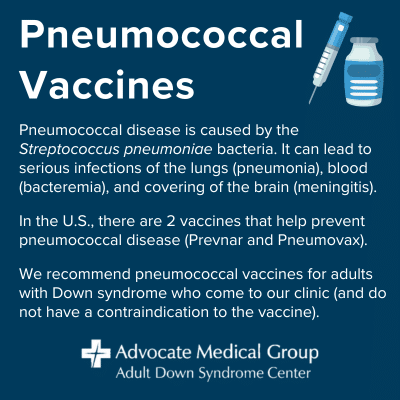
Pneumococcal disease is caused by Streptococcus pneumoniae bacteria. It is a leading cause of vaccine-preventable illness and death in the United States. Anyone can get pneumococcal disease, but some people are at greater risk than others:
- People ages 50 years and older
- The very young
- People with certain health problems
- People with a weakened immune system
- People who smoke
Pneumococcal disease can lead to serious infections of the:
- Lungs (pneumonia)
- Blood (bacteremia)
- Covering of the brain (meningitis)
According to the Centers for Disease Control and Prevention (CDC), pneumococcal pneumonia causes death in about 1 in 20 people who get it.
Studies on pneumonia and respiratory infections have shown that pneumonia more commonly affects people with Down syndrome compared to people without Down syndrome. A study of patients in our health system found that people with Down syndrome had 4 times greater odds of developing pneumonia than people without Down syndrome. Pneumonia is a common problem treated at the Adult Down Syndrome Center, a frequent cause for admission to the hospital, and one of the leading causes of death in patients served at the Center.
How can pneumococcal disease be prevented?
Pneumococcal vaccines help prevent pneumococcal disease. There are two types of pneumococcal vaccines in the United States:
- Pneumococcal conjugate vaccines: PCV15 (Vaxneuvance), PCV20 (Prevnar 20), and PCV21 (CAPVAXIVE). An older version, PCV13, is no longer recommended.
- Pneumococcal polysaccharide vaccine: PPSV23 (Pneumovax23)
The differences among the vaccine options are related to how the vaccines work in the body, which bacteria strains against which the vaccine protects, and how many bacteria strains against which the vaccine protects.
Who should get pneumococcal vaccines?
The CDC recommends pneumococcal vaccination for:
Children
All children younger than 5 years old
Children 5 through 18 years old with certain risk conditions
Adults
All adults 50 years or older
Adults 19 through 49 years old with certain risk conditions
The type and number of doses recommended for a person depends on their age and whether they have previously received pneumococcal vaccines. The CDC website has additional information:
Recommended pneumococcal vaccines for children
Recommended pneumococcal vaccines for adults
What are the “certain risk conditions”?
The CDC website lists several factors that can increase someone’s risk for pneumococcal disease including age, certain racial and ethnic groups, childcare attendance, and medical conditions.
What should people with Down syndrome consider?
While Down syndrome is not specifically listed as a “certain risk condition,” immunocompromising conditions (or having a weakened immune system) are included in the list. Immune system deficiency is a common finding in people with Down syndrome. Additionally, as mentioned above, pneumonia occurs more frequently in people with Down syndrome. Therefore, at the Adult Down Syndrome Center, we include Down syndrome in the list of risk conditions.
What is our approach?
There are many factors to consider when deciding which pneumococcal vaccines to get, at what age to get them, and how many doses to get. Our approach is a modification of the recommendation of the CDC based on the experience of serving individuals with Down syndrome at the Adult Down Syndrome Center. This information should be discussed with your healthcare professional and not taken as a personal medical recommendation.
Ages 19-49
For an adult with Down syndrome who has not received any pneumococcal vaccines as an adult (ages 19 or older): We recommend one dose of PCV20 or PCV21. The choice of PCV20 vs. PCV21 depends on individual risk factors and which strains of pneumococcal bacteria are prevalent in your local area.
For an adult with Down syndrome who has received one PPSV23: We wait one year after the PPSV23 dose and then recommend one dose of PCV20 or PCV21.
For an adult with Down syndrome who has received two PPSV23 vaccines: We wait one year after the second PPSV23 dose and then recommend one dose of PCV20 or PCV21.
For an adult with Down syndrome who has received one dose of PCV13 or PCV15 but not PPSV23: We recommend waiting one year and then getting one dose of PCV20 or PCV21.
For an adult with Down syndrome who has received one dose of PCV13 or PCV15 and one dose of PPSV23: We wait five years after the PPSV23 and then recommend one dose of PCV20 or PCV21.
Ages 50 and older
For an adult with Down syndrome who has not received any pneumococcal vaccines as an adult (ages 19 or older): We recommend one dose of PCV20 or PCV21.
For an adult with Down syndrome who has received one dose of PCV13 or PCV15 before age 50: We wait one year after the PCV13 or PCV15 and then recommend one dose of PCV20 or PCV21.
For an adult with Down syndrome who has received one dose of PCV13 or PCV15 and one dose of PPSV23 before age 50: We wait five years after the PPSV23 and then recommend one dose of PCV20 or PCV21.
For an adult with Down syndrome who has received one or two doses of PPSV23 before age 50: We wait one year after the last PPSV23 and then recommend one dose of PCV20 or PCV21.
Resources
Down syndrome
DSMIG-USA Statement on Vaccines (Down Syndrome Medical Interest Group-USA)
Pneumonia in People with Down Syndrome (Adult Down Syndrome Center)
General
Pneumococcal Disease: Causes and How It Spreads (CDC)
Pneumococcal Disease Symptoms and Complications (CDC)
Pneumococcal Vaccination (CDC)
Recommended Pneumococcal Vaccines for Adults (CDC)
Recommended Pneumococcal Vaccines for Children (CDC)
Types and Composition of Pneumococcal Vaccines (CDC)
Types of Pneumococcal Vaccines (CDC)
References
Fitzpatrick V, Rivelli A, Chaudhari S, et al. Prevalence of infectious diseases among 6078 individuals with Down syndrome in the United States. J Patient Cent Res Rev. 2022;9(1):64-69. doi:10.17294/2330-0698.1876
Santoro SL, Chicoine B, Jasien JM, et al. Pneumonia and respiratory infections in Down syndrome: A scoping review of the literature. Am J Med Genet A. 2021;185(1):286-299. doi:10.1002/ajmg.a.61924
Join our mailing list
Sign up to receive emails with information on health topics for teens and adults with Down syndrome, updates on research and education as well as information about upcoming events, classes and programs.